
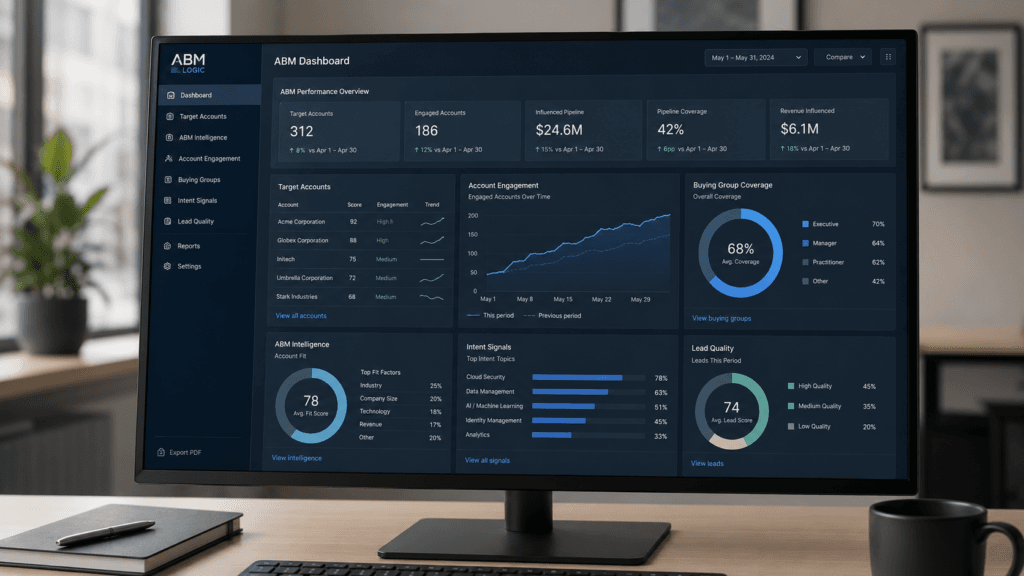



In brief
ABM data is the information sales and marketing teams need to select target accounts, understand buying groups, create relevant engagement, qualify leads and measure account progression. The most useful account-based marketing data includes firmographic data, technographic data, intent data, engagement data, stakeholder data, buying group coverage, CRM data and sales follow-up context.
The goal is not to collect every possible data point. The goal is to gather enough reliable account intelligence to decide which accounts matter, which roles need engagement, what signals are meaningful and what sales or marketing should do next.
In this article
- The main types of ABM data
- Firmographic data
- Technographic data
- Intent data and engagement data
- Stakeholder and buying group data
- CRM and sales data
- Data quality matters
- FAQs about ABM data
Introduction: Why ABM data matters
Account-based marketing depends on focus.
That focus is only as strong as the data behind it. If the target account list is weak, the buying group is unclear or engagement data is disconnected from sales follow up, the programme can create activity without useful pipeline progression.
Selecting the right ABM data helps answer practical questions:
- Which accounts fit the ICP?
- Which accounts should be prioritised?
- Which roles matter inside the buying group?
- Which accounts are engaging?
- Which content topics are creating interest?
- Which leads are useful for sales?
- Which accounts are moving toward pipeline?
Without good data, these decisions become guesswork.
The main types of ABM data
A useful ABM data model should support account selection, audience building, lead qualification, sales follow up and measurement.
The most important data types usually include:
- Firmographic data
- Technographic data
- Intent data
- Engagement data
- Stakeholder data
- Buying group data
- CRM data
- Sales follow-up data
- Pipeline and opportunity data
These data types work best when they are connected. Firmographic data may identify a good-fit account. Intent data may show topic interest. Buying group data may reveal relevant stakeholders. CRM data may explain account history. Sales feedback may show whether the signal was useful.
Firmographic data
Firmographic data describes the basic profile of an account. This can include company size, industry, revenue, employee count, geography, ownership type, market segment and business model.
Firmographic data is often the starting point for target account selection. It helps teams define which companies broadly match the ideal customer profile.
However, firmographic data is not enough on its own. A company may be the right size and in the right sector but still have poor timing, weak buying group visibility or limited commercial relevance.
Firmographic data tells you who could be relevant. It does not always tell you who should be prioritised.
Technographic data
Before using an installation record to select accounts, check the product, operating company, location and evidence date. Our technographic data validation checklist for ABM sets out the fields to request and how to handle uncertain records.
Technographic data describes the technology environment inside an account.
This can include CRM systems, ERP systems, marketing automation platforms, cloud providers, analytics tools, security tools or other installed technologies.
For many B2B companies, technographic data is important because the current technology environment can indicate fit, opportunity, complexity or readiness.
A company using a relevant legacy system may be a strong target. A company already using a competitor may need a different message. A company with a compatible technology stack may be easier to engage.
Technographic data becomes more useful when connected to business context, intent data and sales knowledge.
Intent data and engagement data
Intent data and engagement data help show what accounts may be researching or interacting with.
This can include:
- Website visits
- Content downloads
- Webinar attendance
- Email engagement
- Third-party topic interest
- Repeat page visits
- Content syndication responses
- Event registrations
- Direct enquiries
In ABM, intent data should be treated as a signal, not proof of buying readiness.
A single content download does not prove a live project. A third-party topic surge does not guarantee budget. But when intent data appears in a target account, from a relevant role, around a meaningful topic, it can become a useful account signal.
This is why ABM teams should connect intent data to account fit, buying group relevance and sales follow up.
Stakeholder and buying group data
Accounts do not buy, people inside accounts buy. That is why stakeholder and buying group data is essential for account-based marketing.
Crucial buying group data includes:
- Senior decision-makers
- Functional owners
- Technical evaluators
- Finance stakeholders
- Procurement contacts
- Operational users
- Influencers
- Champions
- Known blockers
The purpose is not simply to collect names. The purpose is to understand which roles matter, where coverage is strong, where gaps exist and which stakeholders are engaging.
Buying group data improves lead quality because each lead can be interpreted in relation to the wider account.
CRM and sales data
CRM data is often one of the most important ABM data sources, but it is not always used well.
Sales teams may already know account history, relationship strength, blockers, opportunities, closed lost reasons, renewal dates, existing contacts and political context.
This information can dramatically improve account selection and follow up.
Useful CRM and sales data includes:
- Account owner
- Open opportunities
- Past conversations
- Deal stage
- Known stakeholders
- Previous objections
- Customer status
- Renewal dates
- Next actions
- Sales feedback
ABM works better when marketing activity is connected to this sales context.
Data quality matters
Poor data leads to weak or poor ABM. If account names are inconsistent, contacts are outdated, job titles are inaccurate or engagement cannot be matched to accounts, the programme becomes harder to manage.
Data quality does not need to be perfect, but it does need to be reliable enough for action.
Teams should focus on:
- Clean account records
- Accurate contact fields
- Consistent account ownership
- Reliable consent records
- Clear target account tags
- A practical lead-to-account matching process
- A way to capture sales feedback
The aim is not a perfect database. The aim is a usable operating system.
What data should be prioritised first
A practical ABM data model should start with the essentials.
- Target account list
- ICP fit data
- Account tier
- Buying group roles
- Known contacts
- Engagement history
- Lead qualification status
- Sales owner
- Follow-up status
- Pipeline or opportunity status
This creates enough visibility to run the programme and improve over time. More advanced data can be added later, but the foundation must be usable.
What to measure
ABM data should be measured by whether it improves account decisions and sales action.
Useful measures include target account match rate, stakeholder coverage, buying group coverage, engagement by account tier, lead quality, sales acceptance, follow-up completion and pipeline generated or influenced.
If data does not help the team make better decisions, it may not be the right data to prioritise.
How to build a simple ABM data model
A practical ABM data model does not need to start with complex technology. It should start with the fields the team needs to make better account decisions.
At a minimum, the model should show:
- Account name
- Account owner
- ICP fit
- Account tier
- Industry or segment
- Key buying group roles
- Known contacts
- Engagement history
- Intent or topic signals
- Lead qualification status
- Sales follow-up status
- Opportunity or pipeline stage
This gives sales and marketing a shared account view.
The aim is not to replace the CRM. The aim is to make the account-based process easier to manage. If the CRM already supports this cleanly, use it. If the CRM is incomplete, a controlled spreadsheet or reporting layer may help while the process matures.
How to keep ABM data actionable
Turn the relevant evidence into an account decision using our ABM account research brief template. It connects sources and stakeholder responsibilities to a named next action, with unknowns recorded for review.
ABM data becomes weak when it is collected but not used, and every major data field should support a decision.
Account tier should influence the level of investment. Buying group coverage should influence content and outreach. Engagement history should influence follow-up. Lead qualification should influence routing. Sales feedback should influence future targeting.
If a field does not support a decision, it may not belong in the first version of the model.
A useful checklist to keep in mind is:
- Will this data help us choose accounts?
- Will this data help us reach the right people?
- Will this data help us qualify signals?
- Will this data help sales follow up?
- Will this data help leadership understand progression?
If the answer is yes, the data is probably useful. If not, it may be noise.
Data governance for ABM teams
Data quality depends on ownership. Someone needs to own the account list. Someone needs to own contact quality. Someone needs to review engagement signals. Someone needs to capture sales feedback.
Without ownership, ABM data decays quickly. This ownership can be tricky to set up; one of the best ways to do this is by introducing a governance model
A simple governance rhythm can include:
- Weekly review of new engaged accounts
- Monthly review of buying group coverage
- Monthly review of lead quality and sales feedback
- Quarterly review of account tiers and ICP fit
- Regular cleanup of duplicate or outdated records
This is not administration for its own sake. It protects the quality of the account-based operating model.
ABM data should make the programme easier to trust.
How to think about data for account-based marketing
For teams thinking about data for account-based marketing, the starting point should be usefulness, not volume. The data should help the team choose better accounts, understand buying group roles, interpret engagement and decide what sales or marketing should do next.
If a data point does not improve account selection, qualification, follow-up or reporting, it may not belong in the first version of the model.
When the data cannot answer the question
One software client’s relevant technology sat behind the scenes, so front-end signals and purchased data did not give us the answer we needed. As described in our account-based demand-generation methodology, surveys helped reveal segments that the existing data had missed.
The lesson is to write down the decision before shopping for another dataset. If you need to know about an internal process, a public technology tag may never resolve it. Ask a question that can close that gap, and leave the answer unknown until you have evidence.
FAQs about ABM data
What data do you need for ABM?
ABM teams need firmographic data, technographic data, intent data, engagement data, stakeholder data, buying group data, CRM data and sales follow-up data.
Why is data important in account-based marketing?
Data is important because ABM depends on selecting the right accounts, reaching the right buying group roles, interpreting engagement and deciding what sales or marketing should do next.
Is intent data enough for ABM?
No. Intent data is useful, but it should be combined with account fit, buying group relevance, CRM context and sales insight.
What is the biggest ABM data mistake?
The biggest mistake is collecting data without connecting it to action. ABM data should help the team prioritise accounts, qualify signals and support pipeline progression.
Final thoughts
ABM data is not about collecting more information for its own sake. It is about making better account decisions.
The best account-based marketing data helps teams choose the right accounts, understand the right stakeholders, interpret engagement signals, qualify leads and measure pipeline progression.
For ABM Logic, data quality sits underneath account selection, buying group coverage, lead qualification and account-level reporting. Without that data foundation, activity becomes harder to trust and harder to turn into pipeline.
Explore how ABM Logic structures our account-based programmes around target accounts, buying groups and qualified account signals, using cleaner data to support account selection, qualification and reporting.