
Direct answer
Account-based marketing examples are B2B campaigns or plays built around selected target accounts rather than a broad audience. Strong ABM examples show which accounts are being targeted, which buying group roles matter, what content or channel is used, what engagement signal is created, and what sales action should follow.
The best account based marketing examples are not just creative campaign ideas. They are structured account plays that connect targeting, relevance, buying group engagement, qualification and pipeline progression.
In practical terms, an ABM example should make the operating logic visible. It should show the account focus, the stakeholder focus, the message, the signal, the follow-up and the commercial purpose.
In this article
- What makes an account-based marketing example useful
- Why ABM examples should show the mechanism, not just the campaign idea
- One-to-one ABM examples for strategic accounts
- One-to-few ABM examples for account segments
- Account-based lead generation examples
- Content syndication examples in ABM
- Event-led ABM examples
- Buying group engagement examples
- Customer expansion ABM examples
- How to choose the right ABM play for your account strategy
Introduction
Many articles on account-based marketing examples focus on big brand case studies or creative campaign ideas.
Those can be interesting, but they are not always useful for B2B teams trying to build their own ABM programme.
A good ABM example should do more than show that a campaign happened. It should explain how the play worked.
- Which accounts were targeted?
- Which buying group roles were involved?
- What content or channel created engagement?
- What signal did the campaign produce?
- What did sales do next?
- How did the activity support account progression?
That is the useful way to think about ABM examples.
Account-based marketing is not just a creative wrapper around normal demand generation. It is a structured way of focusing sales and marketing around the accounts that matter most.
So the examples below are not meant to be copied exactly. They are practical patterns B2B teams can adapt based on account value, buying group complexity, sales objective and pipeline stage.
For the broader definition, read our practical guide to account-based marketing.
What makes an ABM example useful?
An ABM example is useful when it shows the connection between account strategy and commercial action.
A weak example only describes the tactic. It says a company ran ads, sent direct mail, hosted an event or created personalised content.
A stronger example explains the operating logic behind the tactic.
Useful ABM examples usually include:
- The target account or account segment
- The reason those accounts were selected
- The buying group roles being targeted
- The problem or priority being addressed
- The content or campaign asset used
- The channels used to create engagement
- The signal created by the activity
- The sales follow-up or next action
- The pipeline purpose of the play
This is important because ABM should not be judged by activity alone. A campaign can look creative, but if it does not help the right accounts progress, it is not doing the job of ABM.
Example 1: Strategic one-to-one ABM account play
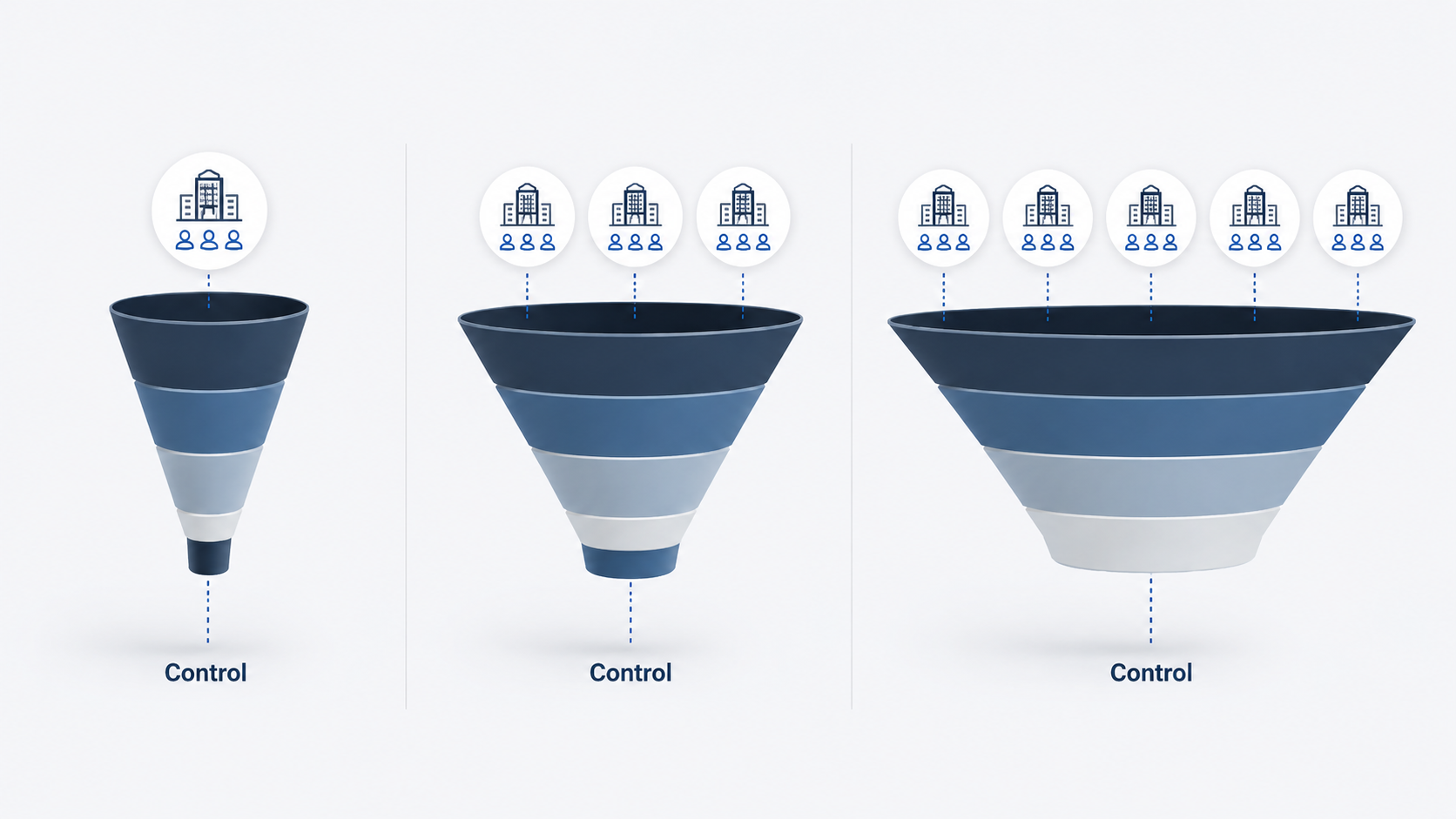
A one-to-one ABM play focuses on a small number of high-value accounts.
This example is useful when the account has enough potential value to justify deeper research, more tailored content and close sales involvement.
The target might be one enterprise account that sales already wants to win, expand or influence.
The account focus:
- One strategic account
- High commercial value
- Known sales owner
- Clear reason for focus
- Possible existing relationship or live opportunity
- The buying group focus:
- Senior sponsor
- Functional owner
- Technical evaluator
- Commercial decision-maker
- Known influencers or blockers
The campaign might use account research, stakeholder mapping, tailored messaging, executive briefing content, LinkedIn engagement, sales outreach and a small personalised landing page or briefing asset.
The signal created might be engagement from a senior stakeholder, a reply from a known contact, a meeting request, or multiple stakeholders interacting with the same account-specific content.
The sales action is not a generic follow-up. Sales should use the account context to open a more relevant conversation around the account’s likely priorities, current pressures or strategic direction.
The pipeline purpose is to create or accelerate a meaningful account conversation.
Example 2: One-to-few ABM segment campaign
A one-to-few ABM campaign targets a small group of accounts with shared characteristics.
This works when several accounts face a similar problem, operate in the same market, use similar technology or fit the same proposition.
The account focus:
- A defined segment or cluster
- Shared industry or business challenge
- Similar account size or buying context
- Enough commonality to support shared messaging
- The buying group focus:
- Similar stakeholder roles across the account cluster
- Common decision-maker profile
- Shared functional or technical concerns
- Sales teams assigned to specific accounts
For example, a software provider may target 40 manufacturing companies that are modernising legacy systems. The campaign may use sector-specific messaging, a practical guide, LinkedIn ads, email nurture and coordinated sales follow-up.
The content is not fully bespoke for every account, but it is more relevant than a generic market campaign.
The signal created might be content engagement from target accounts, repeat visits from the account cluster, or multiple contacts engaging with the same problem-led asset.
The sales action is to prioritise accounts showing engagement and tailor outreach around the shared segment challenge.
The pipeline purpose is to create focused movement across a group of commercially similar accounts.
Example 3: Account-based lead generation campaign
An account-based lead generation campaign is designed to create qualified leads from a defined account universe. This is different from broad lead generation because the campaign starts with target accounts rather than collecting contacts first and checking fit later.
The account focus:
- A larger target account list
- Clear ICP criteria
- Defined sectors, regions or company sizes
- Accounts selected before campaign launch
- The buying group focus:
- Relevant job functions
- Decision-makers, influencers or evaluators
- Contacts who can reveal account interest
- Roles that sales understands and can follow up
The campaign may use content syndication, LinkedIn targeting, email, landing pages, webinar promotion, retargeting and phone-based qualification where appropriate.
The content should be specific enough to create a useful signal. A broad awareness piece may generate volume, but a problem-specific guide, framework or diagnostic asset can reveal more meaningful interest.
The signal created is a qualified lead from a target account.
The sales action depends on the qualification level. Some leads may go to nurture. Some may require human qualification. Some may be ready for direct follow-up. Multiple leads from the same account may justify a more coordinated account review.
The pipeline purpose is to turn scalable engagement into useful account-level signals.
Example 4: Content syndication ABM play
Content syndication can support ABM when it is used to reach selected accounts and create qualified engagement signals.
Used poorly, it becomes a volume tactic. Content is distributed widely, leads are collected and sales receives contacts with limited context.
Used well, it becomes part of an account-based lead programme.
The account focus:
- A defined target account universe
- ICP-fit companies
- Specific regions, sectors or segments
- Accounts sales is willing to review
- The buying group focus:
- Relevant roles matched to the content topic
- Stakeholders likely to care about the problem
- Contacts who may help map the wider buying group
The campaign may promote a guide, report, webinar or framework through a trusted content channel. The asset should connect clearly to a problem the target accounts are likely to recognise.
The signal created is not simply a download. The signal is that someone from a target account engaged with a topic connected to the business problem.
The sales action may include qualification, account review, buying group mapping, nurture or follow-up from the account owner.
The pipeline purpose is to identify which target accounts are showing topic-level interest and make that engagement actionable.
Example 5: Event-led ABM play
Events can work well in ABM when they are built around target account engagement rather than registration volume alone. This could be a webinar, roundtable, executive briefing, partner event, workshop or private dinner.
The account focus:
- Priority accounts invited intentionally
- Accounts selected by strategic value or current opportunity
- Sales-owned accounts with clear follow-up responsibility
- The buying group focus:
- Senior decision-makers
- Functional leaders
- Technical or operational stakeholders
- Existing champions
- Potential internal sponsors
The campaign may use personalised invitations, LinkedIn outreach, email, phone follow-up, partner introductions and post-event content.
The signal created may include registrations from target accounts, attendance from relevant roles, questions asked during the event, post-event content engagement or requests for follow-up.
The sales action should be planned before the event happens. Sales should know which accounts are attending, which roles are represented, what follow-up message will be used and how quickly action should happen.
The pipeline purpose is to deepen account engagement and create a natural reason for sales conversation.
Example 6: Buying group engagement play
A buying group engagement play is designed to expand visibility beyond one contact inside a target account. This is useful when sales knows an account but does not have enough stakeholder coverage.
The account focus:
- Known target account
- Existing contact or early engagement
- Incomplete stakeholder map
- Need for wider influence inside the account
- The buying group focus:
- Decision-maker
- Functional owner
- Technical evaluator
- Finance or procurement stakeholder
- User or operational influencer
The campaign may use role-specific content, LinkedIn targeting, tailored email sequences, sales introductions and retargeting around a shared account theme.
Each stakeholder should not necessarily receive the same message.
A senior leader may need a commercial outcome message. A technical evaluator may need proof of feasibility. A functional owner may need operational relevance.
The signal created may be engagement from new stakeholders, repeat engagement from different roles, or a clearer view of who is involved in the decision group.
The sales action is to update the account view and decide whether the account is ready for broader follow-up, nurture or a more specific sales play.
The pipeline purpose is to improve account coverage and reduce reliance on one lead or one relationship.
Example 7: Intent-triggered ABM play
An intent-triggered ABM play uses account activity or market signals to decide when an account deserves attention.
This can include first-party engagement, content interaction, website visits, event activity, third-party intent signals, leadership changes, funding, expansion or other account changes.
The account focus:
- Accounts already on the target account list
- Accounts showing relevant movement
- Accounts with stronger fit and timing signals
- The buying group focus:
- Roles connected to the signal topic
- Stakeholders who may care about the business issue
- Contacts already known to sales or marketing
- The campaign may use targeted content, sales review, account research, tailored outreach, LinkedIn engagement or a focused nurture path.
- The key is not to treat intent as proof of buying readiness.
- Intent is a signal, not a conclusion.
The signal created may be a spike in topic interest, repeated website engagement, multiple contacts engaging, or a relevant account change that creates a reason to reach out.
The sales action should match the strength of the signal. A light signal may justify nurture. A stronger account-level pattern may justify sales review or direct outreach.
The pipeline purpose is to prioritise attention when accounts show signs of movement.
Example 8: Customer expansion ABM play
ABM is not only for new business. It can also support customer expansion, cross-sell, upsell and retention.
The account focus:
- Existing customer accounts
- Accounts with expansion potential
- Accounts where the relationship is too narrow
- Accounts with new teams, regions or business units to reach
- The buying group focus:
- Existing champion
- New stakeholder groups
- Senior sponsor
- Functional leaders in adjacent teams
- Commercial or procurement contacts
The campaign may use customer-specific insight, relevant success stories, executive summaries, value review content, stakeholder education and coordinated account owner follow-up.
The signal created may be engagement from new contacts inside the customer, interest in additional use cases, attendance at a customer briefing or requests for more information.
The sales action is to connect engagement to account planning.
The pipeline purpose is to expand the relationship beyond the original buyer and create new commercial opportunities inside an existing account.
How to choose the right ABM example for your situation
The right ABM play depends on account value, buying stage, available data, sales capacity and campaign objective.
A small number of high-value accounts may justify one-to-one ABM. A defined group of similar accounts may fit a one-to-few segment play. A larger account universe may need account-based lead generation. An active sales opportunity may need buying group engagement. A known customer may need an expansion play.
Useful questions include:
- How valuable are the accounts?
- How many accounts are included?
- How well do we understand the buying group?
- Is the goal awareness, engagement, lead generation, sales conversation or expansion?
- What content or offer will create a useful signal?
- Does sales have capacity to follow up?
- How will account progression be measured?
These questions matter more than copying a campaign idea from another company. ABM works when the play matches the account strategy.
What all strong ABM examples have in common
The strongest ABM examples have a common structure.
They start with clear account selection. They understand the buying group. They use relevant messaging. They create engagement through appropriate channels. They treat leads and interactions as account-level signals. They define what sales should do next. They measure progression, not just activity.
That is the difference between ABM and a normal campaign aimed at a list of companies. The account logic comes first. The campaign follows.
FAQs about account-based marketing examples
What is an example of account-based marketing?
An example of account-based marketing is a campaign built around a defined set of target accounts instead of a broad audience. For example, a B2B company may target 50 priority accounts with role-specific content, LinkedIn engagement, email outreach and sales follow-up designed to create account-level engagement and pipeline progression.
What are ABM plays?
ABM plays are structured sales and marketing actions designed to create movement in target accounts. A play may focus on a strategic account, a one-to-few segment, account-based lead generation, content syndication, event follow-up, buying group engagement, intent-triggered outreach or customer expansion.
What makes an ABM example effective?
An ABM example is effective when it shows the account focus, buying group roles, content or channel used, engagement signal created, sales follow-up and pipeline purpose. The best examples are not just creative campaign ideas; they show how the account strategy turns into action.
What is a one-to-one ABM example?
A one-to-one ABM example is a highly focused play for one strategic account. It may include account research, stakeholder mapping, tailored messaging, executive briefing content, LinkedIn engagement and direct sales follow-up designed to open or progress a specific account conversation.
What is a one-to-few ABM example?
A one-to-few ABM example targets a small group of accounts with shared characteristics, such as the same industry, business challenge or technology environment. The campaign uses segment-specific messaging and content to create engagement across that account cluster.
How does content syndication support ABM?
Content syndication supports ABM when it distributes relevant content to selected target accounts and creates qualified engagement signals. The value is not only the download; it is the account context behind the download, including company fit, role relevance, buying group coverage and follow-up readiness.
How are ABM examples different from normal marketing campaigns?
ABM examples are different because they start with target accounts and buying groups rather than a broad market. Success is measured by account engagement, stakeholder coverage, sales action and pipeline progression, not only by clicks, downloads or lead volume.
How do you choose the right ABM play?
Choose the right ABM play based on account value, number of accounts, buying group visibility, available content, sales capacity and the commercial objective. Strategic accounts may need one-to-one ABM, while larger account segments may need scalable account-based lead generation or content syndication.”
Final thoughts
Account-based marketing examples are most useful when they show how the account strategy works in practice.
A good example should not only describe a campaign. It should show the account focus, the buying group, the content or channel, the signal created, the sales action and the pipeline purpose.
For B2B teams, that is the practical value.
ABM is not about running more creative campaigns. It is about focusing sales and marketing around the accounts that matter most and creating useful engagement that can be acted on.
If your team wants to turn target accounts into practical ABM plays, ABM Logic can help structure account selection, campaign design, buying group engagement, lead qualification and sales follow-up around the accounts that matter most. Explore our account-based programmes or speak to ABM Logic about building practical account-based marketing campaigns.”