
Direct answer
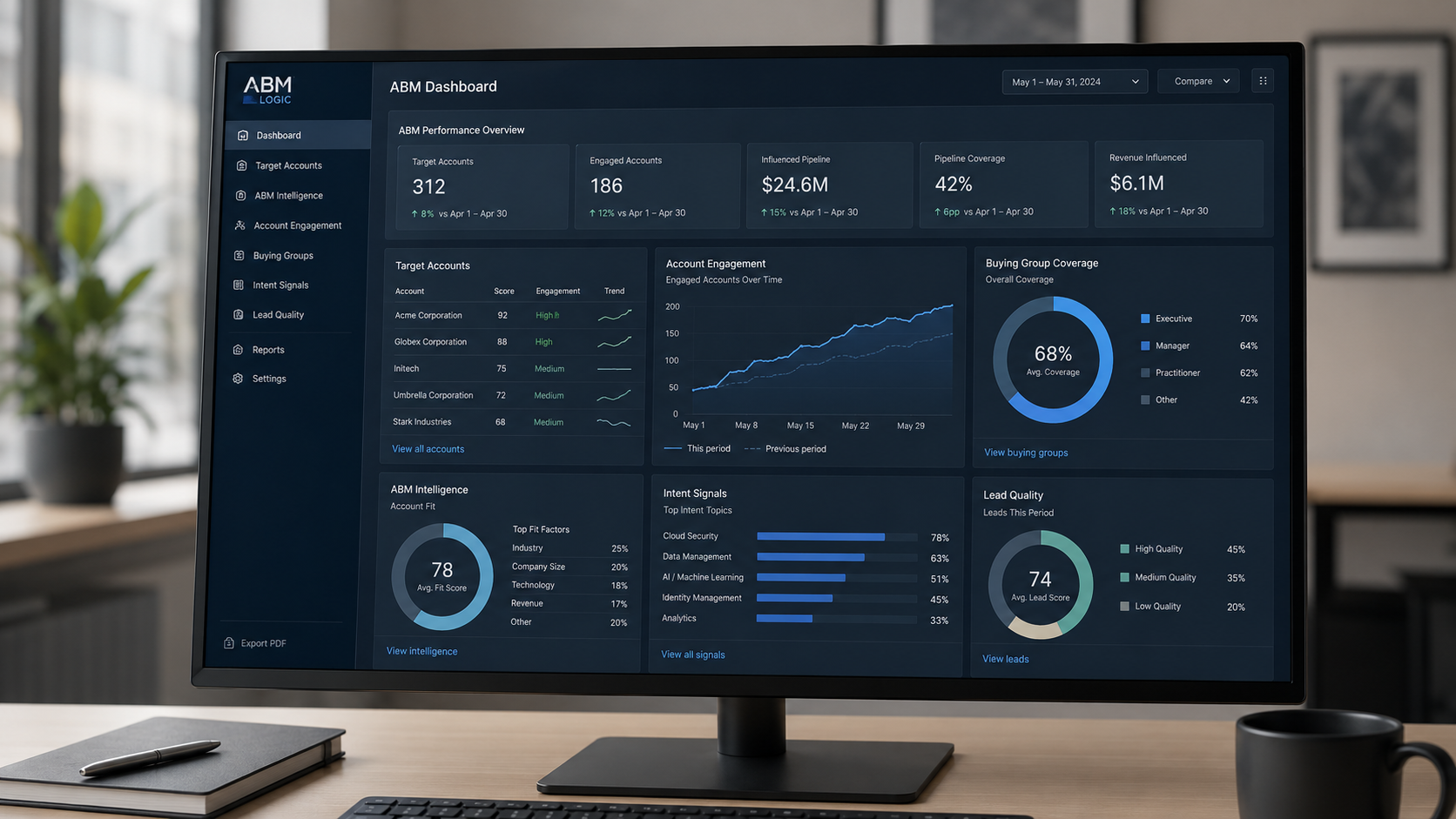
ABM metrics should measure whether the right accounts are engaging, whether the buying group is becoming visible, whether sales is acting on the signals, and whether accounts are progressing toward pipeline. Useful ABM metrics include target account engagement, buying group coverage, lead-to-account match rate, sales acceptance, follow-up completion, meetings created, opportunities influenced and pipeline progression.
The mistake many B2B teams make is measuring account-based marketing like a normal campaign. Clicks, impressions, downloads and form fills can be useful, but they do not prove that target accounts are moving forward.
A stronger ABM measurement model focuses on account progression, not just campaign activity.
In this article
- Why ABM metrics need to go beyond activity
- The difference between campaign metrics and account progression metrics
- Which ABM metrics matter most
- How to measure target account engagement
- How to measure buying group coverage
- How to measure lead quality and account signals
- How to measure sales follow-up and acceptance
- How to connect ABM metrics to pipeline impact
- How to build a practical ABM reporting model
- Common ABM measurement mistakes to avoid
- ABM is often measured with the wrong dashboard.
Introduction
A team launches activity into target accounts. Ads run. Content is downloaded. Emails are opened. Leads are created. Campaign reports show activity.
But the most important question remains unanswered. Are the right accounts actually progressing?
That is the measurement challenge in account-based marketing.
ABM is not designed only to create campaign engagement. It is designed to help sales and marketing focus their efforts on selected accounts and buying groups. That means the measurement model has to show whether target accounts are becoming more visible, more engaged and more commercially actionable.
If ABM is measured only by lead volume, clicks or impressions, the team can easily mistake activity for progress.
A better model measures account movement.
Why ABM metrics need to be different
Account-based marketing is different from broad demand generation because the account is the main unit of focus.
That changes how performance should be measured.
In a traditional campaign, marketing may report how many people viewed an ad, clicked an email, downloaded a guide or filled in a form. Those numbers are useful for understanding campaign activity, but they do not show whether the activity came from the accounts sales actually cares about.
In ABM, the question is different.
The team needs to know:
- Which target accounts engaged?
- Which account tiers are responding?
- Which buying group roles are visible?
- Are multiple stakeholders engaging inside the same account?
- Are the leads relevant and qualified?
- Did sales accept and act on the signals?
- Did the account move closer to a commercial conversation?
This is why ABM metrics need to connect engagement, account context and sales action. Without that connection, reporting can show activity without showing account progression.
Metrics only matter when they connect to strategy. For the planning layer, read our guide to building an account-based marketing strategy.
Campaign activity versus account progression
Campaign activity tells you what happened in the campaign.
Account progression tells you whether the campaign helped move target accounts forward. Both matter, but they are not the same.
Campaign activity may include:
- Impressions
- Clicks
- Email opens
- Content downloads
- Form fills
- Webinar registrations
- Page views
- Cost per lead
- Account progression may include:
- Target accounts engaging
- New stakeholders identified
- Buying group coverage improving
- Relevant roles interacting with content
- Sales accepting account signals
- Follow-up completed
- Meetings created
- Accounts moving into active review
- Pipeline generated or influenced
The problem is not that campaign metrics are useless. The problem is that they are incomplete.
An ABM campaign can generate activity from the wrong accounts. It can also generate low activity overall but meaningful engagement from a small number of strategic accounts.
Account progression metrics help teams understand the difference.
Metric 1: Target account engagement
Target account engagement is one of the most important ABM metrics.
It shows whether activity is coming from the accounts the business has chosen to prioritise.
This metric should answer:
- Which target accounts engaged?
- How many target accounts engaged?
- Which account tiers showed engagement?
- What type of engagement occurred?
- Which topics or assets created engagement?
- How engagement changed over time
This matters because not all engagement is equal.
A content download from a company outside the target account list may still be useful, but it does not carry the same strategic value as engagement from a high-priority account.
A stronger reporting view should separate target account engagement from general market engagement.
That allows sales and marketing to see whether the programme is reaching the accounts it was designed to influence.
Metric 2: Engagement by account tier
Not every target account has the same value. That is why engagement should be measured by account tier.
A Tier 1 strategic account may justify deep research, tailored content and sales involvement. A Tier 3 account may be part of a broader account-based lead programme. These accounts should not always be measured in exactly the same way.
Engagement by account tier helps answer:
- Are high-priority accounts engaging?
- Are lower-tier accounts creating scalable signals?
- Are resources being directed to the right accounts?
- Are Tier 1 accounts receiving enough sales and marketing attention?
- Are Tier 2 or Tier 3 segments responding to the campaign theme?
This metric helps avoid a common reporting issue.
A programme may look strong because many lower-tier accounts are engaging, while the strategic accounts remain quiet. That may still be useful, but leadership should understand the difference.
Tiered reporting makes that clear.
Metric 3: Lead-to-account match rate
Lead-to-account match rate shows how many leads or engaged contacts come from the target account universe.
This is especially important for account-based lead programmes and content syndication campaigns.
A campaign may generate a large number of leads, but if few match the target account list, the output may have limited ABM value.
Lead-to-account match rate helps answer:
- How many leads came from target accounts?
- How many came from non-target accounts?
- Which account segments produced the strongest match?
- Are targeting criteria working?
- Is the campaign attracting the right companies?
This metric connects lead generation to account strategy. It prevents teams from judging lead volume without understanding whether the leads came from commercially relevant accounts.
A high lead-to-account match rate does not automatically prove pipeline value, but it is a useful sign that the campaign is aligned to the target account universe.
Metric 4: Buying group coverage
Buying group coverage measures whether the right roles inside an account are becoming visible or engaged.
This is central to ABM because complex B2B purchases are rarely made by one person.
A single lead from a target account may be useful, but multiple relevant stakeholders engaging from the same account can be much more meaningful.
Buying group coverage can include:
- Number of engaged stakeholders in an account
- Roles represented in the account
- Decision-maker engagement
- Functional stakeholder engagement
- Technical evaluator engagement
- Finance or procurement visibility
- Known contacts versus missing roles
- Expansion of contact coverage over time
This metric helps sales and marketing understand whether engagement is isolated or spreading across the account. It also supports better follow-up.
If only one role is engaging, the next step may be nurture or stakeholder mapping. If several roles are engaging with related topics, the account may deserve more focused sales review.
Metric 5: Content engagement by topic
Content engagement matters most when it tells the team what the account cares about. In ABM, it is not enough to know that someone downloaded an asset. The topic of engagement matters.
A broad awareness article may suggest early interest. A diagnostic guide, comparison piece, problem-specific framework or commercial briefing may indicate a more focused concern.
Content engagement by topic helps answer:
- Which topics are attracting target accounts?
- Which assets are engaging relevant roles?
- Which themes are creating repeat engagement?
- Which content supports sales follow-up?
- Which topics are connected to pipeline movement?
This metric can improve both marketing and sales. Marketing can see which themes are resonating. Sales can use the engagement topic to shape a more relevant follow-up conversation.
The goal is not only to report content performance. The goal is to understand what content reveals about account interest.
Metric 6: Qualified account signals
A qualified account signal is engagement that becomes meaningful when viewed in account context.
For example, a single form fill from an unknown company may be a light signal. A content download from a relevant stakeholder at a priority account may be stronger. Multiple stakeholders from the same account engaging with related content may be stronger still.
Qualified account signals may include:
- A target account engaging with high-value content
- A relevant buying group role downloading an asset
- Multiple contacts from the same account engaging
- Repeat engagement over a short period
- Engagement with later-stage content
- A direct reply or request for information
- An event registration from a priority account
- A meaningful intent or account change signal
This metric is useful because it moves beyond raw engagement. It asks whether the signal is commercially meaningful.
That is where ABM measurement becomes more useful than standard campaign reporting.
Metric 7: Sales acceptance
Sales acceptance shows whether sales believes the lead, signal or account activity is worth action.
This is an important bridge between marketing activity and commercial value.
If marketing reports strong engagement but sales rejects most signals, there may be a problem with targeting, qualification, message relevance or handoff context.
Sales acceptance can measure:
- Accepted leads from target accounts
- Accepted account signals
- Accounts moved into sales review
- Signals rejected by sales
- Reasons for rejection
- Feedback by campaign or content topic
This metric should not be used to blame sales or marketing. It should be used to improve the operating model.
If sales rejects signals because the account is wrong, account selection needs work. If the account is right but the role is weak, buying group targeting may need improvement. If the role is right but the context is unclear, the handoff needs to improve.
Metric 8: Follow-up completion
ABM can fail after engagement is created. A target account may respond, a relevant lead may arrive, or several stakeholders may engage, but if sales follow-up does not happen, the signal loses value.
Follow-up completion measures whether the agreed next action actually happened.
It can include:
- Sales outreach completed
- Account owner notified
- Lead routed correctly
- Follow-up completed within agreed timeframe
- Nurture sequence triggered
- Account review completed
- Buying group map updated
- Meeting requested or booked
This is a practical but important metric.
ABM depends on coordinated action. If marketing creates account signals but the follow-up process is weak, the programme will struggle to influence pipeline.
Follow-up completion shows whether the operating model is working.
Metric 9: Meetings created from target accounts
Meetings are not the only measure of ABM success, but they are important when the programme is designed to create sales conversations.
The key is to measure meetings from target accounts, not just meetings overall.
Useful views include:
- Meetings created from target accounts
- Meetings by account tier
- Meetings by buying group role
- Meetings influenced by content engagement
- Meetings from specific campaigns or plays
- Meetings accepted by sales
- Meetings that progress to opportunities
This metric helps connect engagement to sales activity.
However, teams should avoid forcing every ABM programme to produce immediate meetings. Some ABM activity is designed to create awareness, buying group visibility or account intelligence before the account is ready for direct conversation.
The meeting metric should match the programme objective.
Metric 10: Pipeline generated or influenced
Pipeline is often the metric leadership cares about most. That is understandable, but it needs careful interpretation in ABM.
ABM may generate pipeline directly from target account campaigns. It may also influence pipeline by supporting existing opportunities, warming accounts, expanding buying group engagement or improving sales follow-up.
Useful pipeline measures include:
- Pipeline generated from target accounts
- Pipeline influenced by ABM activity
- Opportunities created from engaged accounts
- Pipeline by account tier
- Opportunity progression after ABM engagement
- Sales cycle movement in engaged accounts
- Expansion pipeline in existing customers
- The important point is attribution discipline.
ABM should not claim influence just because an account was exposed to a campaign. The reporting should show a reasonable connection between account engagement, sales action and opportunity movement.
A good ABM reporting model is honest about what marketing created, supported or influenced.
Building a practical ABM reporting model
A practical ABM reporting model should connect activity to account progression. It does not need to be over-engineered at the beginning.
A simple model can track:
- Target account list
- Account tier
- Engaged accounts
- Engaged contacts
- Buying group roles
- Content topics
- Lead qualification status
- Sales acceptance
- Follow-up status
- Meetings created
- Pipeline stage or opportunity movement
This gives sales and marketing a shared view of what is happening. The reporting should help the team decide what to do next, not just look backwards at performance.
For example, the report should help identify accounts that need sales review, accounts that need nurture, accounts with missing stakeholders, accounts showing strong topic interest and accounts where follow-up has not happened.
That is what makes ABM measurement operational.
Common ABM measurement mistakes
ABM measurement often goes wrong when teams use the wrong success measures.
Common mistakes include:
- Measuring only impressions or clicks
- Treating all leads as equal
- Ignoring target account match
- Reporting engagement without account tier
- Measuring one contact instead of the buying group
- Claiming pipeline influence too loosely
- Failing to track sales acceptance
- Failing to track follow-up completion
- Not capturing sales feedback
- Using dashboards that do not change behaviour
These mistakes make ABM look either better or worse than it really is. Good measurement should create clarity.
It should show whether the programme is reaching the right accounts, engaging the right people, creating useful signals and supporting sales progression.
What this means for ABM teams
ABM metrics should help teams make better decisions. They should not exist only for reporting.
If the right accounts are not engaging, the team may need to revisit targeting, messaging or channels. If the accounts are engaging but the buying group is too narrow, contact coverage may need work. If leads are relevant but sales does not follow up, the operating process needs attention. If meetings are created but pipeline does not progress, the quality of the account or message may need review.
This is why account progression is the most useful measurement frame.
It connects marketing activity to sales action and commercial movement.
FAQs about ABM metrics
How do you measure ABM?
ABM should be measured by whether the right accounts are engaging, whether the buying group is becoming visible, whether sales is acting on the signals, and whether accounts are progressing toward pipeline. Useful metrics include target account engagement, buying group coverage, sales acceptance, follow-up completion, meetings created and pipeline influenced.
What are the most important ABM metrics?
The most important ABM metrics are target account engagement, engagement by account tier, lead-to-account match rate, buying group coverage, qualified account signals, sales acceptance, follow-up completion, meetings created from target accounts and pipeline generated or influenced.
What is account progression in ABM?
Account progression means movement from one stage of account engagement to the next. This could include a target account becoming aware, engaging with content, showing multiple stakeholder signals, entering sales review, booking a meeting, becoming an opportunity or moving further through the pipeline.
Why are campaign metrics not enough for ABM?
Campaign metrics are not enough because clicks, impressions, downloads and form fills do not show whether the right accounts are moving forward. ABM needs account-level metrics that connect engagement to target accounts, buying groups, sales follow-up and pipeline progression.
How do you measure buying group coverage?
Buying group coverage can be measured by the number and type of stakeholders engaged inside a target account. This may include decision-makers, functional leaders, technical evaluators, finance or procurement contacts, users, influencers and champions.
What is lead-to-account match rate?
Lead-to-account match rate shows how many leads or engaged contacts come from the target account universe. It helps teams understand whether lead generation activity is aligned to the accounts sales and marketing actually want to reach.
How should ABM pipeline influence be measured?
ABM pipeline influence should be measured by connecting account engagement, sales action and opportunity movement. Useful views include pipeline generated from target accounts, opportunities influenced by ABM activity, progression after engagement and pipeline by account tier.
What is the difference between ABM reporting and normal campaign reporting?
Normal campaign reporting often focuses on activity such as clicks, downloads and leads. ABM reporting should show account-level progress, including target account engagement, buying group coverage, qualified signals, sales follow-up and pipeline impact.
Final thoughts
ABM metrics should not only show that campaigns were active. They should show whether target accounts are moving.
That means measuring account engagement, buying group coverage, qualified account signals, sales acceptance, follow-up completion, meetings, opportunities and pipeline progression.
For B2B teams, this is the practical difference between reporting activity and managing account-based growth.
If your team is running ABM or account-based lead programmes but struggling to show account progression, ABM Logic can help structure reporting around target accounts, buying groups, qualified signals and pipeline impact. Explore our account-based programmes or speak to ABM Logic about account-level reporting and measurement.