



In brief
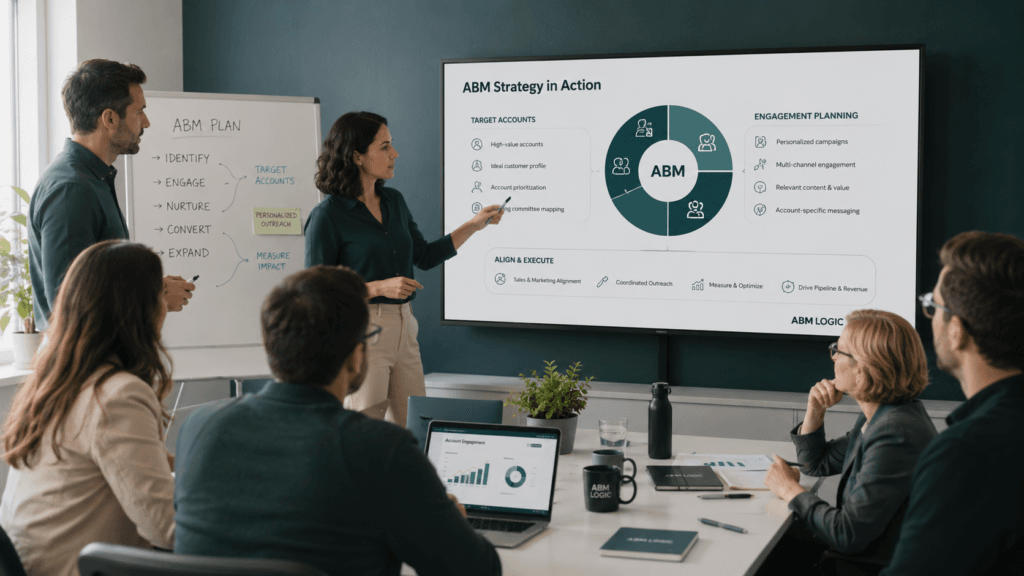
ABM implementation is the practical process of turning account-based marketing strategy into a working operating model. It includes defining the commercial objective, selecting target accounts, tiering those accounts, mapping buying groups, building messaging, choosing channels, setting qualification rules, aligning sales follow up and measuring account progression.
The strongest ABM implementation process is sequential. It does not start with channels. It starts with the accounts and the commercial outcome the business wants to create.
In this article
- Step 1: define the commercial objective
- Step 2: define the ICP and target account criteria
- Step 3: build and validate the account list
- Step 4: tier the accounts
- Step 5: map the buying group
- Step 6: build messaging and content
- How to sequence the first 90 days
- FAQs about ABM implementation
Introduction: Why ABM implementation needs structure
Many teams understand the idea of account-based marketing but struggle to implement it.
They create a target account list, run some ads or emails and call it ABM. But without clear account ownership, buying group logic, qualification rules and sales follow up, the activity can become disconnected from pipeline.
Implementation matters because ABM is not only a campaign type. It is a way of organising sales and marketing around the accounts that matter most.
A practical ABM implementation process gives the team a shared operating model.
Step 1: define the commercial objective
The first step is to decide what the ABM programme is meant to achieve.
Possible objectives include:
- Opening conversations with strategic accounts
- Generating qualified leads from target accounts
- Supporting an existing sales opportunity
- Expanding customer relationships
- Building buying group coverage
- Warming an account list before outreach
- Improving sales and marketing alignment
The objective shapes the rest of the implementation. A programme designed to influence five strategic accounts will look different from an account-based lead programme targeting hundreds of ICP-fit companies.
Step 2: define the ICP and target account criteria
Before selecting accounts, the team needs to define what makes an account worth pursuing.
Useful criteria include industry, company size, geography, revenue, technology environment, business model, growth stage, operational complexity, existing relationship strength and likely business problem.
The ICP should be practical. It should help sales and marketing separate good-fit accounts from accounts that only look interesting on the surface.
Good account selection is the foundation of ABM implementation.
Step 3: build and validate the account list
The target account list should be built from data and sales input. Marketing may bring market insight, intent signals and engagement history. Sales may bring relationship context, account ownership, timing, blockers and commercial judgement.
A strong ABM implementation process combines both.
The aim is not to build the biggest account list. The aim is to build a list that sales and marketing both agree is worth working.
Step 4: tier the accounts
Not every account should receive the same treatment, and account tiering helps match effort to value.
Tier 1 accounts may receive deeper research and one-to-one engagement.
Tier 2 accounts may receive segment or cluster messaging.
Tier 3 accounts may receive scalable account-based lead generation.
Tiering prevents two common mistakes: over-personalising too many accounts and under-serving strategic accounts.
Step 5: map the buying group
ABM should not be built around one contact.
The team should define which buying group roles matter for the offer. These may include economic decision-makers, functional owners, technical evaluators, finance stakeholders, procurement, users, influencers and champions.
Buying group mapping helps marketing create more relevant content and helps sales understand who needs to be reached.
It also improves lead qualification because each lead can be interpreted in relation to the account and role.
Step 6: build messaging and content
ABM messaging should connect the account or segment to a real business problem.
The messaging framework should define the problem, the account context, the stakeholder concern, the commercial outcome, the reason to act and the next step.
Content should support the buying journey.
Early content can educate. Mid-stage content can help compare approaches. Later-stage content can support sales conversations and internal decision-making.
The point is not to create more content. The point is to create content that helps the right accounts move.
Step 7: choose the channel mix
Channels should follow the account strategy.
Useful ABM channels include:
- Content syndication
- Account-based advertising
- Retargeting
- Webinars
- Events
- Direct outreach
- Phone-based qualification
The right mix depends on account tier, buying group, content, budget and objective. The goal is not to use every channel. The goal is to create coordinated engagement from the right accounts and stakeholders.
Step 8: define qualification and handoff rules
Before launching, the team must agree what counts as a meaningful signal.
Useful criteria include account fit, target account status, role relevance, engagement topic, buying group coverage, lead type, sales ownership and follow-up readiness.
This prevents confusion when leads arrive.
Some leads may go to sales. Some may enter nurture. Some may trigger account mapping. Some may be held until more engagement appears.
Step 9: align sales before launch
Sales should understand the account list, campaign message, content, qualification rules and follow-up expectations before the campaign goes live.
This makes follow up more relevant and improves the chance that marketing activity becomes pipeline progression.
Sales alignment should include ownership, follow-up actions, response times and feedback expectations.
Step 10: measure and improve
ABM implementation should include a review rhythm.
Useful measures include target account engagement, buying group coverage, lead-to-account match rate, sales acceptance, follow-up completion, meetings created and pipeline influenced.
The team should review what is working, what sales accepts, which accounts are moving and where the process needs improvement.
Common mistakes to avoid
Common ABM implementation mistakes include starting with channels before accounts, building the account list without sales input, ignoring buying groups, failing to define lead qualification rules, measuring only activity and launching campaigns without agreed follow up.
These mistakes make ABM look active but weak.
A better implementation process keeps the programme connected to real account movement, not just visible activity.
What ABM implementation looks like by maturity level
Not every team implements ABM from the same starting point. Some teams are just beginning to define their target accounts. Others already have account lists, content, intent data or ABM technology, but lack governance and sales adoption.
- A basic implementation may focus on account selection, tiering and sales alignment.
- An intermediate implementation may add buying group mapping, content planning, multi-channel activation and lead qualification rules.
- A more mature implementation may include account intelligence, intent data, orchestrated plays, deeper reporting and regular account progression reviews.
The right implementation path depends on the team’s maturity, data quality, sales capacity and commercial objective.
The mistake is trying to build the mature version before the basics are stable.
How to sequence the first 90 days
A practical ABM implementation can begin with a simple 90-day structure.
- The first 30 days should focus on strategy and foundations. Define the objective, ICP, account list, tiers, buying group roles and sales ownership.
- The next 30 days should focus on campaign preparation. Build the messaging framework, content plan, channel plan, qualification criteria, handoff rules and reporting model.
- The final 30 days should focus on activation and review. Launch the programme, monitor engagement, review account signals, capture sales feedback and adjust the account or content model.
This sequence prevents the team from launching activity before the account logic is ready, and it creates a realistic path from strategy to execution.
How to know if the implementation is working
ABM implementation is working when the team can see account movement more clearly than before.
Good signs include:
- Sales agrees the account list is relevant
- Account tiers are understood
- Buying group roles are visible
- Content supports the account strategy
- Leads are easier to interpret
- Sales follows up on agreed signals
- Marketing receives useful feedback
- Reporting shows account progression
The programme does not need to be perfect immediately. It needs to become more controlled, more measurable and more useful for sales over time.
Why implementation should stay simple at first
ABM implementation can become too complex too quickly.
Teams may try to build advanced dashboards, intent models, personalisation systems and multi-channel orchestration before they have agreed the account list, qualification rules or sales follow-up process. That creates unnecessary friction.
A better approach is to start with a controlled version of the operating model.
- Define the accounts
- Agree the tiers
- Map the buying group
- Build a simple campaign
- Capture the signals
- Review sales feedback
- Improve the next round
This seven-step process makes implementation manageable.
The programme can become more advanced over time, but the foundations should be easy for sales and marketing to understand from the beginning.
ABM does not need to start as a large transformation project. It can start as a focused account-based operating rhythm that improves with each campaign cycle.
For teams asking how to implement ABM
For teams asking how to implement ABM, the starting point should be account selection, not channels. Channels matter, but they should come after the commercial objective, ICP, target account list, account tiers, buying group model and sales follow-up process are clear.
That order prevents ABM from becoming a collection of disconnected campaign tactics.
Example: a simple 90-day ABM pilot
A practical ABM implementation does not need to begin with a large transformation programme.
A simple 90-day ABM pilot could work like this
During the first 30 days, sales and marketing agree the objective, select 25 to 50 target accounts, define the ICP, tier the accounts and map the buying group roles. The team also agrees what a qualified account signal looks like and who owns follow up.
During the next 30 days, the team builds the campaign assets. This may include one educational article, one practical guide, a landing page, email copy, LinkedIn messaging, sales follow-up notes and a reporting template. The team also checks the CRM data and confirms which contacts or roles are missing.
During the final 30 days, the programme goes live. Marketing monitors target account engagement, content responses and buying group activity. Sales reviews the most relevant account signals and follows up where the role, account and topic justify action.
At the end of the pilot, the team reviews account engagement, lead quality, sales acceptance, follow-up completion, meetings created and lessons for the next campaign.
This kind of pilot is useful because it keeps ABM practical. It tests the operating model before the business commits to a larger programme. Our ABM pilot use case shows how we bring account selection, content and sales coordination together.
Give the first launch a clear learning job
A pilot is easier to judge when you know what it needs to resolve. Perhaps the audience is reachable but the message is uncertain. Perhaps sales agrees the message but nobody knows how much research each account needs. Pick the uncertainty that could change the larger programme.
Our ABM pilot use case provides a starting point for that discussion. Before launch, agree what would make you expand, revise or stop. If every possible result leads to expansion, the pilot is not giving you a meaningful investment decision.
FAQs about ABM implementation
What is ABM implementation?
ABM implementation is the process of turning account-based marketing strategy into a working sales and marketing operating model.
What are the main steps in ABM implementation?
The main steps include defining the objective, selecting target accounts, tiering accounts, mapping buying groups, building messaging, choosing channels, setting qualification rules and measuring progression.
Why does ABM implementation fail?
ABM implementation often fails when teams start with channels instead of accounts, ignore sales input, lack buying group clarity or fail to define follow-up rules.
How should ABM implementation be measured?
It should be measured by target account engagement, buying group coverage, sales acceptance, follow-up completion, meetings created and pipeline progression.
If your team is struggling to turn engagement into sales action, ABM Logic can help structure the campaign, qualification and handoff process so your ABM implementation is practical, measurable and connected to pipeline progression. Have a look at our account-based programmes for further information.