
Direct answer
Account-based marketing is a B2B growth approach that focuses sales and marketing around selected target accounts rather than a broad market. Instead of trying to generate as many leads as possible and then working out which ones matter, ABM starts by defining the accounts the business wants to win, grow or influence.
A strong ABM model uses account selection, buying group understanding, relevant content, engagement signals, sales follow-up and account-level measurement to help the right accounts progress toward pipeline.
ABM means account-based marketing. In simple terms, the meaning of ABM, or account based marketing, is focusing commercial effort around selected accounts rather than treating every lead, click or contact as equal.
The purpose of ABM is not simply to personalise marketing. The purpose is to create a more controlled way of focusing sales and marketing around the accounts with the greatest potential value.
In this article
- What account-based marketing means in practical B2B terms
- How ABM works across sales and marketing
- Why target accounts and buying groups matter
- How ABM differs from traditional lead generation and demand generation
- What an ABM strategy should include
- Examples of account-based marketing in practice
- How ABM campaigns create engagement signals
- How content syndication can support ABM
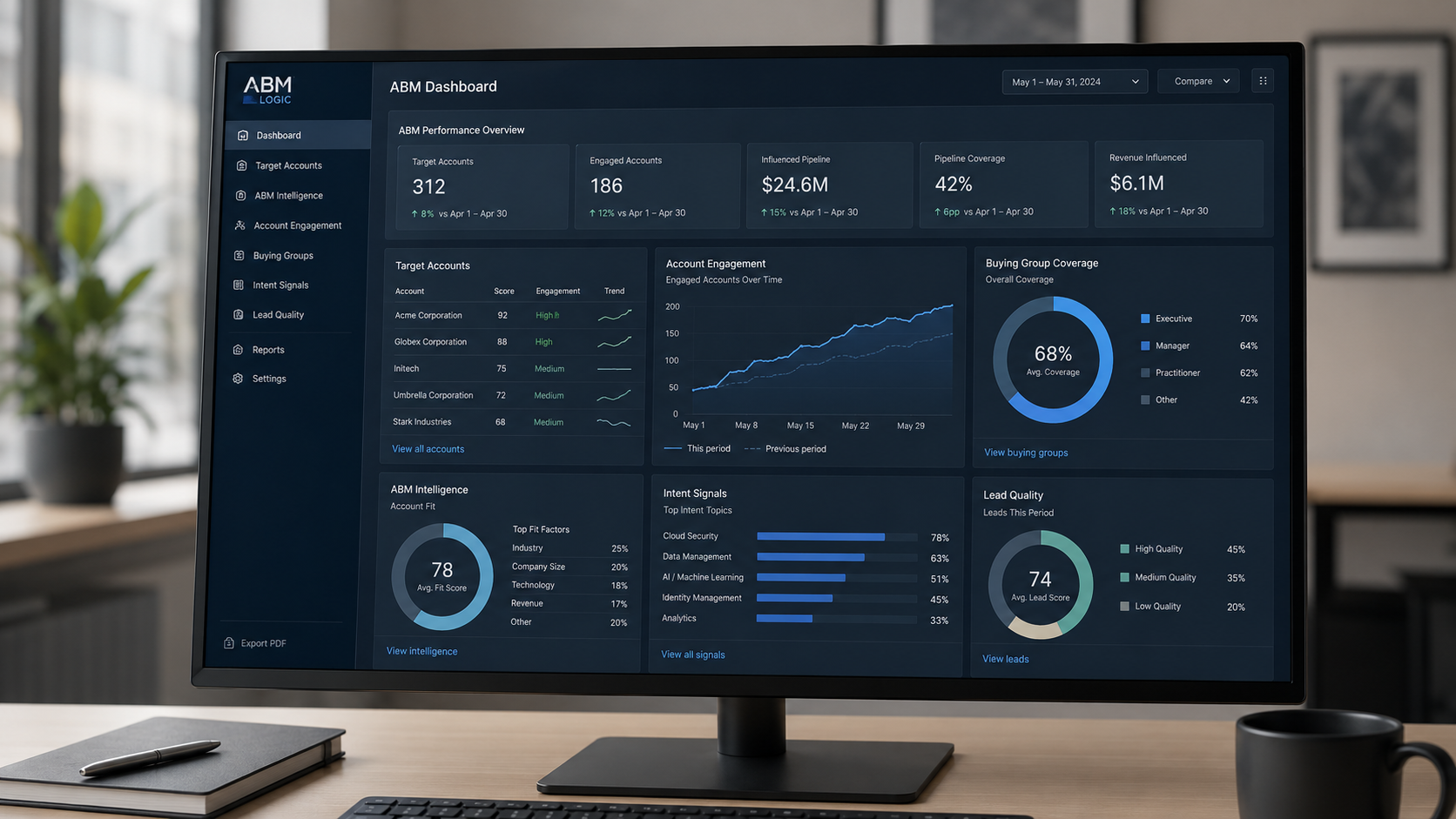
- Which metrics matter when measuring ABM
- When to use an ABM partner
Introduction
Account-based marketing is often described as a focused form of B2B marketing. That is true, but it is not quite enough.
ABM is not just targeting a list of companies with adverts. It is not just adding company names to email copy. It is not just creating personalised landing pages for a few large accounts. At its best, account-based marketing is an operating model.
It gives sales and marketing a shared way to choose the accounts that matter, understand the people involved in the buying process, create relevant engagement, interpret account signals and decide what should happen next.
That makes ABM especially useful in complex B2B markets where deals are larger, buying groups are wider and sales cycles are longer. In these environments, one lead rarely represents the full opportunity. A single content download may be useful, but it does not automatically show whether the account is commercially relevant, whether the right stakeholders are involved or whether sales can progress the conversation.
ABM helps bring that account context into the growth process.
What is account-based marketing?
Account-based marketing is a focused B2B strategy where sales and marketing work together around a defined set of target accounts.
Instead of starting with a broad audience and trying to capture any available demand, ABM starts with the accounts the business wants to influence. Those accounts may be existing customers, strategic prospects, target logos, expansion opportunities or specific segments of the market.
The main idea is simple. Not every account deserves the same level of attention.
Some accounts have stronger fit, higher value, clearer timing, better stakeholder access or greater strategic importance. ABM helps the business identify those accounts and focus activity around them in a more deliberate way.
A practical ABM programme usually includes:
- Target account selection
- Account tiering
- Buying group mapping
- Account or segment-specific messaging
- Relevant content and campaign assets
- Multi-channel engagement
- Sales and marketing coordination
- Lead and account qualification
- Account-level reporting
- Pipeline progression measurement
This is why ABM is different from ordinary campaign planning. The campaign is not the starting point. The account strategy is.
Why ABM matters in B2B marketing
ABM matters because many B2B buying journeys are not simple individual decisions.
In complex sales, the person who first engages with content may not be the budget holder. The person who attends a webinar may not be the technical evaluator. The person who replies to an email may be one stakeholder in a wider decision group.
Traditional marketing can create awareness and leads, but it can struggle to show whether the right accounts are actually moving forward. This creates common problems.
Marketing may report lead volume, but sales may question lead quality. Sales may pursue priority accounts, but marketing activity may not be aligned to those accounts. Campaigns may generate engagement, but the business may not know whether the engagement came from commercially important companies.
ABM helps reduce that gap.
It gives teams a way to ask better questions:
- Which accounts are we trying to win?
- Why do those accounts matter?
- Who is involved in the buying group?
- What problems or priorities are likely to matter to them?
- Which accounts are engaging?
- Which stakeholders are visible?
- What should sales or marketing do next?
These questions are more useful than asking only how many leads a campaign generated.
How account-based marketing works
ABM works by connecting strategy, data, content, channels and sales action around target accounts.
The process usually begins with account selection. Sales and marketing agree which accounts should be prioritised and why. This might involve ideal customer profile fit, revenue potential, market segment, existing relationships, intent signals, recent business changes or strategic value.
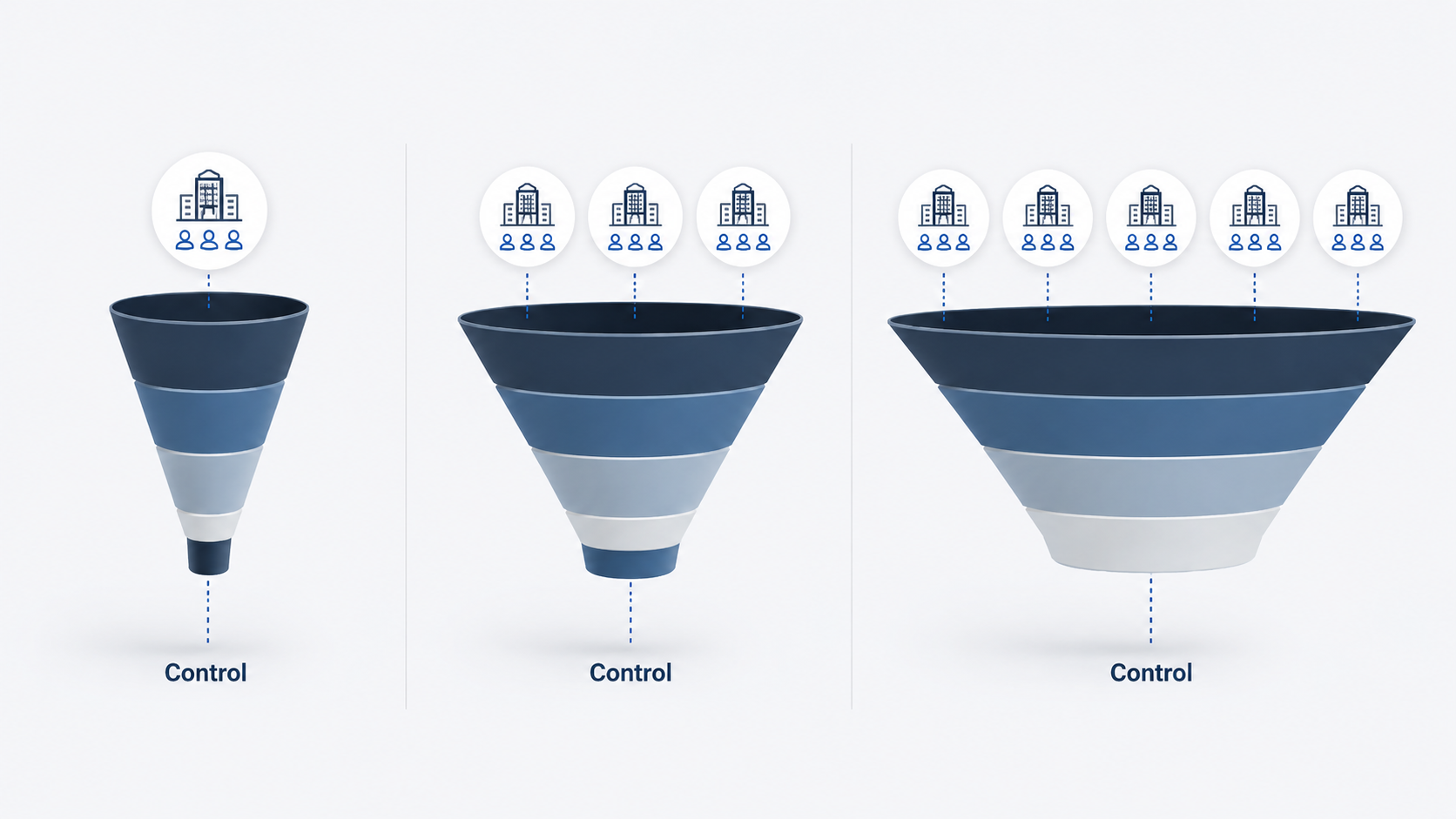
The next step is account tiering. Not all accounts need the same level of investment. A small number of high-value accounts may need deeper research and more personalised engagement. A larger group may be better suited to segment-level campaigns. A broader account universe may be activated through scalable account-based lead programmes.
After that, the team defines the buying group. ABM should not focus only on one job title. It should consider the senior decision-makers, functional leaders, technical evaluators, users, procurement contacts, influencers and internal champions who may shape the buying process.
Then the campaign or programme is built around relevant messages and content. The content should connect to the account’s likely problems, sector context, role priorities or buying stage.
Finally, engagement signals are captured and interpreted. A lead, content download, website visit, event registration or reply is not treated as an isolated action. It is reviewed in account context.
The lead becomes a signal. The account context determines what that signal means.
Target accounts are the foundation of ABM
ABM starts with the account list. This is one of the most important parts of the whole model. If the wrong accounts are selected, even a well-run campaign can struggle to create meaningful pipeline.
A good target account list should not be built from basic firmographics alone. Company size, industry, geography and revenue are useful, but they rarely tell the whole story.
Better account selection considers:
- Ideal customer profile fit
- Commercial value
- Industry or vertical relevance
- Technology environment
- Growth or change signals
- Existing relationship strength
- Engagement history
- Buying group visibility
- Sales priority
- Market timing
ABM is not about building the largest possible list. It is about building a list that sales and marketing can justify, understand and act on. A smaller, better governed account list is often more useful than a large list with weak commercial logic.
Buying groups are central to account-based marketing
A key part of ABM is understanding that accounts do not buy by themselves. People inside accounts buy.
In most complex B2B purchases, there is a buying group. Different stakeholders may care about different things. A senior leader may care about commercial risk and strategic outcomes. A technical evaluator may care about integration, security or feasibility. A functional owner may care about operational improvement. Procurement may care about process, cost and supplier risk.
If marketing only reaches one contact, the account may look engaged but remain commercially weak. ABM therefore needs buying group coverage.
This means understanding which roles matter, which contacts are known, which stakeholders are missing and which messages are relevant to each part of the decision group.
Buying group coverage changes how lead generation is interpreted. One engaged contact can be useful.
Several relevant stakeholders from the same target account can be much more meaningful.
That is why ABM should measure account engagement as well as individual lead activity.
ABM versus traditional lead generation
Traditional lead generation usually starts with the market.
A campaign is launched to reach a broad audience. People respond, fill in forms, download content or register for events. Those contacts are then passed through a qualification process.
This can work when the target market is broad and sales can handle a larger volume of leads.
But in complex B2B sales, lead volume can become misleading.
A campaign may create many contacts, but those contacts may not come from the accounts sales wants to pursue. They may not hold relevant roles. They may not represent real buying group activity. They may require too much sales time to qualify.
Account-based lead generation works differently.
It starts with the accounts. It asks which companies the business wants to create engagement from, then builds the lead generation activity around those accounts and buying groups.
The goal is not just more leads. The goal is better signals from better-fit accounts.
This is why ABM Logic often frames leads as account-level intent signals, not outcomes in themselves. A lead matters because of what it reveals about the account behind it.
ABM and demand generation can work together
ABM does not replace demand generation.
Demand generation creates awareness, education and engagement across a wider market. It helps buyers discover problems, learn about solutions and interact with useful content.
ABM gives that activity account-level direction. The two approaches work best when they are connected.
Demand generation can create useful engagement signals. ABM can help decide which of those signals matter most, which accounts deserve sales attention and which stakeholders need further engagement.
A connected model might work like this:
- Demand generation creates market visibility
- Content and campaigns generate engagement
- Engaged companies are matched against target account criteria
- Priority accounts are reviewed in account context
- Buying group roles are mapped or expanded
- Sales and marketing coordinate follow-up
- Reporting tracks account progression, not only lead volume
This is a stronger model than treating demand generation and ABM as separate activities.
Demand generation creates signal and ABM helps interpret and act on that signal.
How content syndication can support ABM
B2B content syndication can support account-based marketing when it is used to create qualified engagement from the accounts a business already wants to reach.
Used badly, content syndication becomes a volume exercise. Content is distributed widely, leads are collected, and sales receives contacts with limited account context.
Used well, content syndication becomes part of an account-based lead programme.
The campaign starts with a defined account universe. Content is selected or created around a problem those accounts are likely to care about. Engagement is captured from relevant people inside those accounts. The resulting leads are then reviewed against account fit, role relevance, buying group coverage and follow-up readiness.
This makes content syndication more useful than simple lead capture.
It can help identify which target accounts are engaging, which topics are creating interest and which contacts may form part of a wider buying group.
For ABM, the value is not just the download.
The value is the account-level signal created by the download and the action that follows.
What should an ABM strategy include?
An account-based marketing strategy should define how the business will focus effort around the accounts that matter most. It should be more than a campaign calendar.
A practical ABM strategy should include:
- Commercial objective
- Ideal customer profile
- Target account selection criteria
- Account tiers
- Buying group roles
- Messaging framework
- Content plan
- Channel plan
- Sales involvement
- Lead and account qualification rules
- Reporting model
- Pipeline progression measures
The strategy should also define what success looks like.
For some accounts, success may mean opening a first conversation. For others, it may mean expanding buying group engagement, supporting an existing opportunity, increasing awareness before a sales approach, or creating qualified account-level signals.
ABM works best when these expectations are agreed before execution begins. Without that agreement, teams can mistake activity for progress.
For a practical next step, read our guide to building an account-based marketing strategy for B2B teams.
Examples of account-based marketing in practice
ABM can take different forms depending on account value, market size and sales objective.
A one-to-one ABM programme may focus on a small number of strategic accounts. These accounts may receive deeper research, more tailored messaging, custom content and close sales involvement.
A one-to-few ABM programme may focus on a segment or cluster of accounts with a shared challenge. For example, a group of companies in the same industry, facing similar operational pressures, may receive a segment-specific campaign.
A one-to-many account-based lead programme may target a larger group of good-fit accounts at scale. The programme may use content syndication, paid media, email, LinkedIn and follow-up qualification to create engagement from relevant contacts inside target accounts.
An event-led ABM play may focus on driving attendance and follow-up from priority accounts. The event is not just measured by registrations, but by which accounts attended, which roles engaged and what follow-up happened afterwards.
A customer expansion ABM play may focus on growing existing accounts. The programme may identify new stakeholders, promote relevant content and support sales conversations around cross-sell or upsell opportunities.
The format can vary. The account logic should remain consistent.
What is an ABM campaign?
An ABM campaign is a coordinated set of activities designed to create engagement from selected target accounts.
It may include content, email, LinkedIn, paid media, content syndication, webinars, direct outreach, account-based advertising, events or sales follow-up.
The difference between an ABM campaign and a general marketing campaign is the account focus.
An ABM campaign should be clear about:
- Which accounts are being targeted
- Which buying group roles matter
- What message is being used
- What content supports the campaign
- Which channels will be used
- What signal the campaign is trying to create
- How leads will be qualified
- What sales should do next
This makes the campaign easier to measure and easier for sales to act on. The campaign should not end when a lead is generated. It should continue into qualification, follow-up, nurture, account review or sales progression.
Do you need ABM technology?
ABM technology can help, but it is not the strategy.
Platforms can support account identification, advertising, intent data, orchestration, analytics, enrichment and reporting. CRM and marketing automation systems can help route leads, track engagement and coordinate follow-up. These tools can be useful, especially as programmes scale.
But technology cannot replace account logic.
If the account list is weak, technology will scale weak targeting. If the buying group is not understood, automation will not create real relevance. If sales and marketing are not aligned, dashboards will not create progression.
The sequence matters.
First, define the accounts, strategy, buying group, messaging and measurement model, then use technology to support execution.
ABM is a commercial discipline before it is a software category.
How should ABM be measured?
ABM measurement should go beyond activity metrics.
Clicks, impressions, downloads and form fills can be useful, but they do not tell the whole story. A campaign can perform well on activity metrics while still failing to move the right accounts forward.
ABM should measure account progression.
Useful ABM metrics include:
- Target account engagement
- Engagement by account tier
- Lead-to-account match rate
- Buying group coverage
- Number of stakeholders engaged within an account
- Content engagement by topic
- Sales acceptance of leads or signals
- Follow-up completion
- Meetings created from target accounts
- Accounts moved into active sales review
- Pipeline generated or influenced
- Progression by account stage
These measures help sales and marketing understand whether activity is creating commercial movement. The question is not only whether people engaged.
The question is whether the right accounts are becoming more visible, more engaged and more actionable.
Common ABM mistakes to avoid
ABM often fails when teams use the language of account-based marketing without changing the operating model.
Common mistakes include:
- Choosing accounts without sales agreement
- Treating every account the same way
- Personalising copy without improving relevance
- Targeting one job title instead of the buying group
- Measuring only leads or campaign activity
- Passing leads to sales without account context
- Using intent data as proof rather than a signal
- Launching campaigns before defining follow-up
- Expecting technology to fix weak strategy
These mistakes usually come from the same problem. The team has activity, but not enough account structure.
ABM needs governance. It needs clear roles, clear account logic, clear definitions and a shared view of what progress means.
When should a B2B team use ABM?
ABM is most useful when a business needs to focus on specific accounts or segments with meaningful commercial value.
It is especially relevant when:
- Deal sizes justify focused effort
- The buying journey involves multiple stakeholders
- Sales cycles are complex or lengthy
- Sales has named accounts it wants to influence
- Lead quality matters more than lead volume
- Marketing needs to support pipeline progression
- The business wants stronger sales and marketing alignment
- The company needs to grow strategic customers or target new accounts
ABM is not always necessary for every business or every campaign. If the product is low-cost, the market is very broad and the buying process is simple, a traditional demand generation model may be enough.
But when account value, buying complexity and sales focus matter, ABM can provide a stronger operating model.
When to use an ABM partner
A B2B team may use an ABM partner when it needs help turning account-based ambition into a practical programme.
This can include account selection, target account intelligence, campaign strategy, content planning, buying group coverage, account-based lead generation, content syndication, qualification, reporting or sales activation.
An ABM partner can be useful when the internal team has the strategy but not the execution capacity. It can also help when the business has marketing activity running but lacks account-level structure.
The right partner should not simply offer more leads or more campaigns.
It should help answer the deeper questions:
- Which accounts matter?
- How should they be prioritised?
- Which buying group roles need engagement?
- What content or campaign will create useful signals?
- How should those signals be qualified?
- What should sales do next?
- How will account progression be measured?
- That is where ABM becomes commercially useful.
FAQs about account-based marketing
What is account-based marketing?
Account-based marketing is a B2B strategy where sales and marketing focus on selected target accounts instead of a broad market. It uses account selection, buying group understanding, relevant content, engagement signals, sales follow-up and account-level measurement to help priority accounts progress toward pipeline.
What does ABM mean in B2B marketing?
ABM means account-based marketing. In B2B, it means organising marketing and sales activity around specific companies the business wants to win, grow or influence. The aim is to create relevant engagement from the right accounts and support account progression rather than simply generate more leads.
How does account-based marketing work?
Account-based marketing works by first selecting the accounts that matter, then mapping the buying group, creating relevant messaging, running coordinated campaigns, capturing engagement signals and aligning sales follow-up around those accounts. The lead is treated as a signal from an account, not as an isolated outcome.
What is an account-based marketing strategy?
An account-based marketing strategy is a structured plan for focusing sales and marketing around selected target accounts. It should define the ideal customer profile, account selection criteria, account tiers, buying group roles, messaging, content, channels, qualification rules, sales follow-up and account-level metrics.
What is an example of account-based marketing?
An example of account-based marketing is a campaign targeting a defined list of priority accounts with content, LinkedIn engagement, email outreach and sales follow-up tailored to a specific business problem. Success would be measured by target account engagement, buying group coverage, meetings created and pipeline progression, not only by lead volume.
How is ABM different from lead generation?
Traditional lead generation often focuses on creating individual contacts from a broad market. ABM focuses on selected accounts and interprets leads in account context. In ABM, a lead is more useful when it comes from a target account, involves a relevant buying group role and creates a clear next step for sales or marketing.
How is ABM different from demand generation?
Demand generation creates awareness, education and engagement across a wider market. ABM gives that activity account-level focus by identifying which target accounts are engaging, which stakeholders are involved and what sales or marketing should do next. The two approaches can work together when demand signals are interpreted through account context.
Do you need ABM software to run account-based marketing?
ABM software can help with account targeting, advertising, intent data, orchestration and reporting, but it is not the strategy. A business should first define its target accounts, buying groups, messaging, sales process and measurement model. Technology should support the ABM operating model, not replace it.
What metrics matter in account-based marketing?
Useful ABM metrics include target account engagement, engagement by account tier, lead-to-account match rate, buying group coverage, content engagement by topic, sales acceptance, follow-up completion, meetings created, opportunities influenced and pipeline progression.
When should a B2B team use ABM?
A B2B team should use ABM when it needs to focus on specific high-value accounts, complex buying groups, longer sales cycles or strategic customer growth. ABM is especially useful when lead quality, sales alignment and account progression matter more than broad lead volume.
Final thoughts
Account-based marketing is not just a marketing tactic. It is a way of organising sales and marketing around the accounts that matter most.
The value of ABM comes from focus. It helps teams define target accounts, understand buying groups, create relevant engagement, interpret signals and measure whether accounts are progressing toward pipeline.
For B2B teams, this matters because lead volume alone does not prove commercial progress. The better question is whether the right accounts are engaging, whether the right people are involved and whether sales has enough context to act.
ABM gives teams a more structured way to answer that question.
If your team wants to focus growth around target accounts, buying groups and qualified account-level signals, ABM Logic can help structure account-based programmes and account-based lead programmes around the accounts that matter most. Explore our account-based lead programmes or speak to ABM Logic about building target-account engagement around the accounts that matter most.