
Direct answer
ABM at scale means running account-based marketing across a wider target account universe without losing account quality, relevance, governance or sales follow up. It is not about making every account fully bespoke. It is about using account tiers, segments, buying group logic, modular content and clear operating rules to reach more accounts while keeping control.
To scale ABM without losing control, teams need strong target account selection, account tiering, structured messaging, buying group coverage, qualification rules, account-level reporting and sales alignment.
In this article
- Why scaling ABM is difficult
- What ABM at scale really means
- How account tiering protects focus
- How segmentation supports relevance
- Why buying group coverage still matters at scale
- How qualification rules protect lead quality
- How to measure account progression at scale
- Common mistakes when scaling ABM
- How ABM Logic thinks about account-based execution at scale
Introduction: Why scaling ABM is difficult
ABM works because it creates focus. Scaling ABM is difficult because scale can weaken that focus.
As more accounts are added, several risks appear:
- The account list becomes too broad
- Messaging becomes generic
- Personalisation becomes shallow
- Buying group coverage becomes weak
- Sales stops trusting the signals
- Reporting focuses on activity instead of progression
- Campaign governance becomes harder
- Follow up becomes inconsistent
This is why ABM at scale needs structure. Without structure, scaling ABM simply recreates traditional demand generation with account-based language attached.
What ABM at scale really means
ABM at scale does not mean treating every account the same. It means building a controlled system for reaching more of the right accounts.
A scalable ABM model should still answer:
- Which accounts matter?
- Why were they selected?
- Which account tier are they in?
- Which buying group roles are relevant?
- Which message or content fits the segment?
- What signal are we trying to create?
- What should sales or marketing do next?
If those questions are not answered, the programme may be large, but it is not properly account-based.
Start with account tiers
Account tiering is one of the most important ways to scale ABM without losing control.
Not every account should receive the same level of effort. A small number of strategic accounts may justify deeper research and one-to-one engagement. A larger group of similar accounts may need one-to-few messaging. A broader ICP-fit universe may be suitable for account-based lead generation.
A tiering model could include:
- Tier 1 accounts for deep strategic ABM
- Tier 2 accounts for segment-led ABM plays
- Tier 3 accounts for scalable account-based lead programmes
This prevents teams from over-investing in low-priority accounts and under-serving the accounts that matter most.
Use segmentation to keep relevance
Scaling ABM should not mean writing completely unique messaging for every account. A better approach is structured relevance.
Accounts can be grouped by industry, region, business challenge, technology environment, buying trigger, account tier or sales priority.
Segmentation allows teams to create messaging that is specific enough to feel relevant but repeatable enough to execute.
For example, a CFO audience may need commercial risk and return. An IT audience may need integration and operational confidence. A sales leader may need pipeline impact. The core campaign theme can remain consistent, while the angle changes by segment or role.
Build modular content and messaging
ABM at scale works best when content and messaging are modular. Instead of creating every asset from scratch, teams can build reusable content blocks around common problems, stakeholder concerns and account stages.
Simple but effective modules include:
- Industry problem statements
- Role-specific value messages
- Use case summaries
- Objection handling notes
- Proof points
- Follow-up email variants
- Sales talking points
- Landing page sections
- Buying group guidance
This creates speed without losing control.
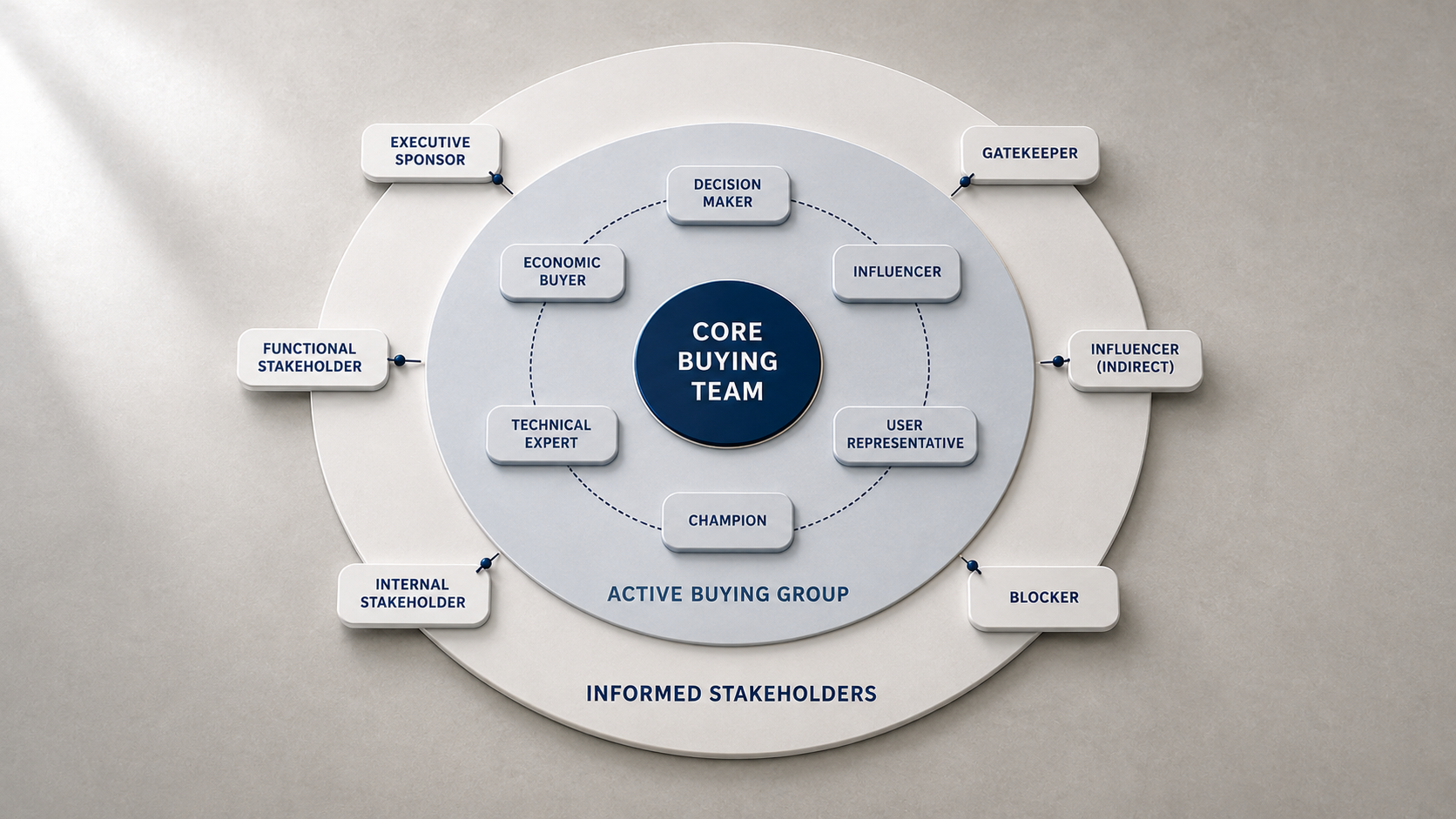
Keep buying group coverage in the model
ABM at scale should not reduce the account to one contact.
Even in scaled account-based lead generation, teams need to understand which roles matter and whether engagement is coming from useful stakeholders.
A scaled programme should still ask:
- Which roles are we trying to reach?
- Which roles are engaging?
- Are multiple people from the same account visible?
- Is engagement isolated or spreading?
- What follow up should happen based on role and topic?
- This keeps the programme account-based even as reach increases.
Define qualification rules before launch
As ABM scales, weak signals can multiply quickly, but with qualification rules in place, lead quality can be protected.
Teams should define what makes an account signal meaningful before the campaign goes live. Useful criteria include account fit, target account status, account tier, role relevance, engagement topic, buying group coverage and follow-up readiness.
The clearer the rules, the easier it becomes to scale without overwhelming sales.
Measure progression, not just volume
ABM at scale should not be measured only by impressions, clicks or lead count.
Helpful metrics include:
- Target account engagement
- Engagement by account tier
- Lead-to-account match rate
- Buying group coverage
- Qualified account signals
- Sales acceptance
- Follow-up completion
- Meetings created
- Pipeline generated or influenced
These metrics show whether the programme is creating meaningful movement inside the accounts that matter.
Common mistakes when scaling ABM
Common mistakes include expanding the account list too far, treating all accounts equally, confusing personalisation with relevance, ignoring buying groups, passing weak signals to sales and measuring activity instead of account progression.
The danger is that the programme looks bigger but becomes less useful. Scale should increase reach without destroying focus.
Build governance before adding more accounts
The first rule of scaling ABM is to build governance before increasing reach. More accounts create more signals, more contacts, more data and more follow-up decisions. If the operating model is weak, scale makes the weakness more visible.
A scaled ABM programme needs to define:
- Who owns the target account list
- How accounts are added or removed
- How account tiers are reviewed
- Which buying group roles matter
- Which signals trigger sales action
- Which signals stay in nurture
- How sales feedback is captured
- How reporting is reviewed
This governance does not need to be heavy. It needs to be clear.
Without it, teams end up with a larger campaign machine but less confidence in the output. Sales may receive too many weak signals. Marketing may struggle to explain which accounts matter. Leadership may see volume but not progression.
Use a scaled ABM operating cadence
Scaling ABM requires a rhythm. A practical cadence might include weekly signal reviews, monthly account tier reviews and quarterly account list refreshes.
Weekly reviews can focus on engaged target accounts, new qualified signals, follow-up gaps and sales feedback.
Monthly reviews can look at buying group coverage, content performance, segment response and account movement.
Quarterly reviews can test whether the account list still reflects commercial priorities.
This cadence helps prevent scaled ABM from becoming static.
The account universe should improve as more data appears. Segments should become sharper, messaging should improve, and sales should become clearer about which signals are useful. Scaled ABM only works when the system has feedback loops in place.
Protect quality as volume increases
As ABM scales, there is always pressure to loosen targeting.
That may create more leads or engagement, but it can reduce quality. The programme may start with carefully selected target accounts and slowly expand into companies that are only loosely relevant.
To avoid this, teams should define quality guardrails.
- Minimum ICP fit
- Relevant geography
- Approved sectors or segments
- Required buying group roles
- Clear lead qualification thresholds
- Agreed sales acceptance criteria
- Account-level reporting by tier
These guardrails protect the programme from drifting into generic demand generation. The point of scaled ABM is not to make the audience as large as possible. It is to reach more of the right accounts while preserving account logic.
How to avoid losing sales confidence at scale
Sales confidence is one of the first things to suffer when ABM is scaled badly.
If sales starts receiving weak leads, poorly explained account signals or engagement from accounts it does not recognise, trust falls quickly. Once that happens, even good signals may be ignored.
To protect sales confidence, scaled ABM needs a clear handoff model.
Sales should understand why an account was included, which tier it belongs to, which role engaged, what content or topic created the signal and what action is recommended. This makes scale feel controlled rather than chaotic.
It also allows sales to give useful feedback. If the account was wrong, account selection can improve. If the role was weak, buying group targeting can improve. If the topic was useful but too early, nurture can improve.
Scaled ABM should create more usable account intelligence, not more unexplained leads.
How to keep reporting useful at scale
Reporting becomes more important as ABM scales because more activity can make the programme harder to interpret.
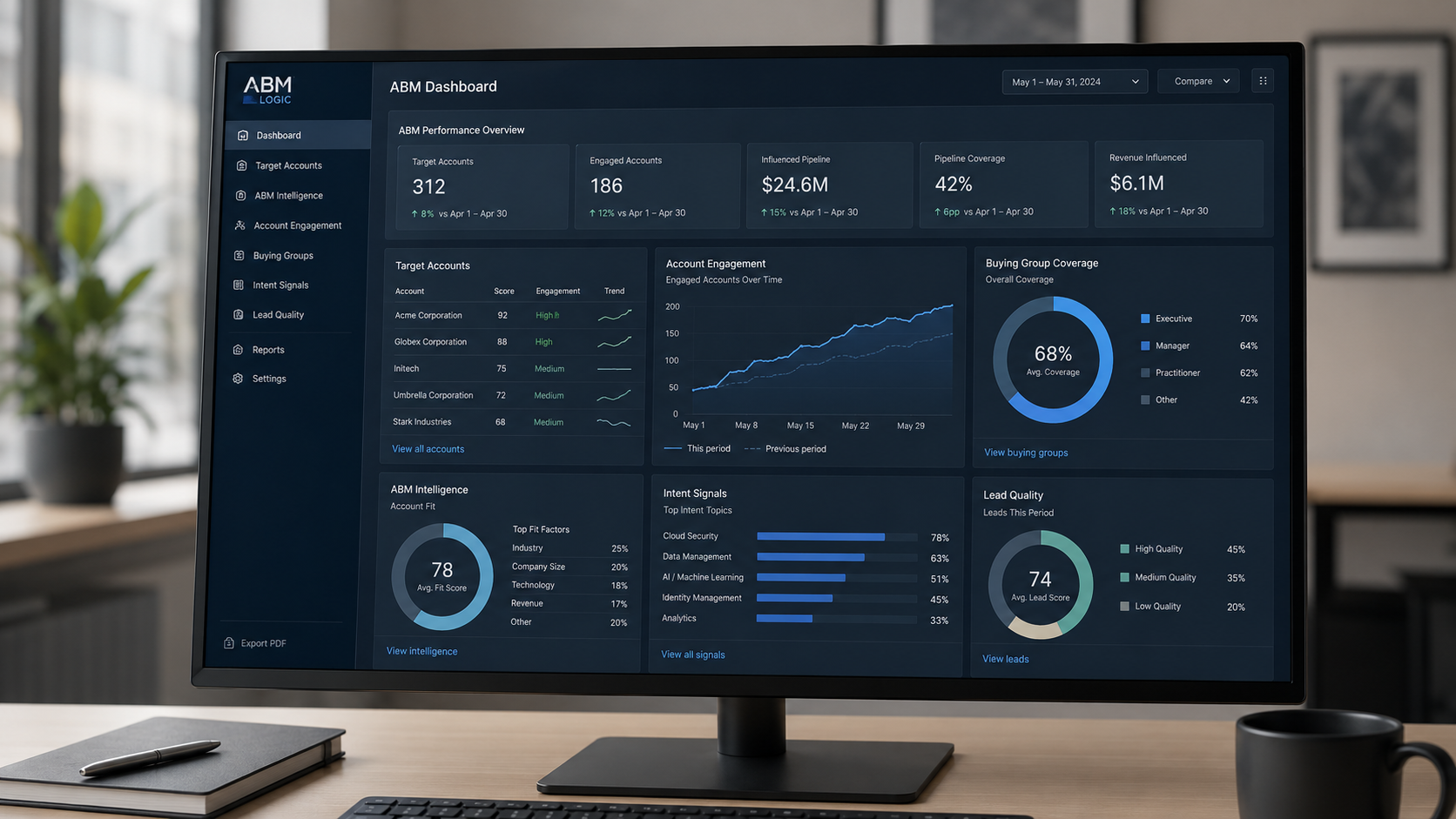
The reporting should not simply show total engagement. It should separate engagement by account tier, segment, buying group role and qualification status.
A useful scaled ABM report should help the team see:
- Which high-priority accounts are engaging
- Which segments are responding
- Which buying group roles are visible
- Which accounts have multiple stakeholders engaged
- Which signals sales accepted
- Which accounts need nurture
- Which accounts need follow up
This keeps scale connected to action. The report should help sales and marketing decide where to focus next, not just prove that activity happened.
ABM Logic point of view
ABM Logic’s view is that scale only works when control is protected.
Account-based execution at scale should still preserve account selection, buying group coverage, structured qualification, sales handoff and account-level reporting. If those controls disappear, ABM can become broad demand generation with account-based language attached.
The aim is not simply to reach more accounts. The aim is to reach more of the right accounts with enough structure for sales to act on the signals created.
FAQs about ABM at scale
What does ABM at scale mean?
ABM at scale means applying account-based marketing principles across a larger group of target accounts using tiers, segments, repeatable content and clear operating rules.
Can ABM be scaled without losing personalisation?
Yes, but the goal should be structured relevance rather than total personalisation. Segments, buying group roles and modular messaging help teams stay relevant at scale.
What is the biggest risk when scaling ABM?
The biggest risk is losing account focus. If the account list becomes too broad or the signals become too weak, ABM can turn into generic demand generation.
How should scaled ABM be measured?
Scaled ABM should be measured by target account engagement, account tier response, buying group coverage, sales acceptance, follow-up completion and pipeline progression.
Final thoughts
Scaling ABM is not about doing more personalisation at any cost. It is about building a controlled operating model that can reach more accounts while preserving account logic.
The strongest ABM at scale uses account tiers, segmentation, modular content, buying group coverage, qualification rules and account-level reporting.
For ABM Logic, this is central to account-based execution at scale. Scale is only valuable when the right accounts are reached, the right signals are created and sales knows what to do next.
Explore how ABM Logic structures account-based programmes around target accounts, buying groups and qualified account signals, so scale does not come at the expense of control, relevance or sales follow-up.”