

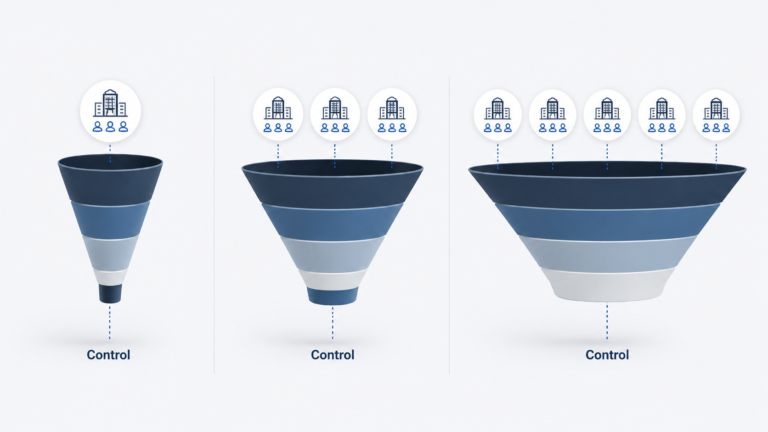

For B2B marketing teams with more priority accounts than they can support individually, the right grouping makes a shared campaign relevant.
At a glance
One-to-few ABM lets your marketing and sales teams work with a small group of accounts through shared campaign material. Group them around a business problem and the evidence buyers need, then adapt for individual circumstances. This guide helps you test whether a proposed group can use the same argument before you commission content.
Your sales team has a list of priority accounts, and you can’t create a bespoke campaign for every one. One-to-few ABM gives you a way to share research, content and creative across a smaller group. The important decision is what makes that group worth treating together.
An industry label is a useful starting filter, but it doesn’t give you a campaign argument. Two manufacturers might look almost identical in your CRM while facing different decisions: one is integrating acquisitions; the other needs to reduce downtime. The same case study, message and next step may not help both.
At ABM Logic, account-based programmes start with the target-account universe and the people involved in the buying decision. For a clustered programme, we then need a credible reason to share the work. Use the questions below with your sales team to test where a common campaign will help and where individual attention is still needed.
Group accounts around a shared buying problem
Use a sentence with four parts: the account situation, the problem it creates, the people affected and the decision those people need to make.
For example: “Multi-site service businesses integrating acquired operations need to decide how to standardise customer data without disrupting regional delivery.” That sentence suggests operational, technical and commercial concerns. It also excludes businesses whose immediate issue is something else.
The sentence is a hypothesis until supported by account evidence. Annual reports, public programmes, existing customer conversations and sales notes can help validate it. A broad intent topic or an industry code alone is weaker support.
Record what would disprove the grouping. If an account has already completed the relevant integration, has no local ownership of the decision or faces a different constraint, it may need a different cluster or no campaign at all.
Check what the accounts really have in common
| Dimension | Evidence to collect | A reason to split the cluster |
|---|---|---|
| Business situation | A documented change, pressure or objective | Different underlying reasons for action |
| Buying problem | The decision or trade-off the account faces | Different problems despite similar firmographics |
| Stakeholders | Functions involved and their concerns | Different approval or operating structures |
| Proof required | Examples, technical evidence or commercial justification | One account needs evidence irrelevant to the others |
| Timing | Known initiative, review window or unresolved uncertainty | Active evaluation mixed with general education |
| Next action | A useful, realistic step for the buying group | Incompatible asks or delivery requirements |
Use this worksheet to challenge the grouping, rather than score it into existence. Accounts don’t have to match on every characteristic. They do need a shared problem, useful common evidence and a next step that makes sense for the people you’re trying to engage.
Test whether the buying group can use the same argument
Two accounts may share a technical problem but differ in how decisions are approved. One may need a central architecture team to agree. Another may require regional operational sponsors before procurement becomes involved.
LinkedIn and Bain’s Hidden Buyer Gap research highlights the role of process and risk reviewers alongside product experts in enterprise buying. Its research setting doesn’t define every buying group, but it is a reason to test approval needs rather than targeting only visible technical interest.
Ask whether the shared campaign equips those people to make progress. A technical comparison may help an evaluator while leaving the operational owner unable to explain disruption risk. The cluster might still work if a shared evidence pack covers both needs. If the commercial arguments conflict, splitting it may be more sensible.
For the wider stakeholder context, read what buying groups mean in ABM. Cluster design adds the question of which buying groups can use the same campaign logic.
Why one industry segment might need several campaigns
Say you’ve grouped nine accounts under “enterprise logistics”. In this hypothetical example, research reveals three different situations: four are integrating acquisitions, three are replacing ageing platforms and two are exploring a new market. You now have a more useful basis for planning than the industry label alone.
The first four could share a proposition about maintaining operational continuity during integration. Their core asset could compare transition options, identify ownership questions and provide a planning checklist. Account-specific introductions would reference only verified circumstances.
The platform-replacement accounts need a different argument about migration, compatibility and the risk of remaining on the current system. Reusing the integration campaign would save production time but weaken relevance. The two exploratory accounts may belong in broader education until their situation is clearer.
The result is two potential clusters and a monitored group, not one nine-account campaign. Those numbers are illustrative. There is no useful universal cluster size independent of the research, delivery capacity and amount of adaptation required.
Decide what to share and what to personalise
The shared layer should contain the central problem, proposition, evidence, core assets and measures. The account layer should contain verified context, stakeholder gaps, relationship history, contact route and the next appropriate action.
For example, the same integration checklist could support all four accounts, while each receives a different introduction and workshop agenda. One account might need an operational discussion first. Another already has a sponsor and needs an architecture review.
Avoid personalisation that merely substitutes the logo and company name. If removing the account reference leaves the argument unchanged, ask whether the adaptation adds useful context. If it doesn’t, the team may be spending effort on decoration rather than relevance.
Our guide to personalisation at scale explores that balance. In one-to-few planning, the test is whether shared production still supports a credible account-level decision.
Agree what progress should look like with your sales team
A cluster should have an objective more specific than “increase engagement”. Define the intended movement: validate the problem, reach a missing function, secure a joint workshop or establish the requirements for evaluation.
Record the starting position for each account. An account with an existing sponsor shouldn’t be judged against the same immediate milestone as one with no relationship. Shared campaign activity can still produce account-specific progress.
Review the cluster after meaningful new evidence appears. If one account enters a detailed procurement process, it may need more individual attention. If another reveals a different priority, revise its assignment rather than forcing the original message to fit.
Try the shared argument before commissioning the campaign
Before developing the full campaign, sketch the central asset in a page of notes. Write the problem, the decision criteria, the evidence and the proposed next step. Then review it account by account with the sales owner.
Ask what would need to change for each account. Different introductions and examples are manageable. If the core problem, proof and next action all need rewriting, the accounts may not belong in one cluster. Record the exception rather than hiding it inside a broad segment label.
The amount of work you can reuse is a useful test of the cluster. If six accounts need six entirely different propositions and workshops, you’re effectively planning several individual programmes. That may be justified, but the budget and workload should reflect it.
6sense’s 2025 buyer-experience study reports substantial prior category and vendor experience among respondents. It is retrospective vendor research, not a description of every account. It reinforces the need to investigate what the cluster already knows rather than assume all buyers need the same introductory education.
Keep a record of cluster changes
Give the cluster a version, inclusion criteria and an owner. When an account moves into or out of it, record the reason: a newly verified priority, a different operating structure, a changed project stage or corrected data.
Maintain the original campaign cohort for reporting even if the current planning group changes. Otherwise, removing non-responding accounts can make the cluster appear more successful without any improvement in the campaign.
During review, separate shared lessons from account-specific lessons. If several accounts ask the same implementation question, improve the core evidence. If one account has a unique approval requirement, adapt its play without forcing that requirement onto everyone else.
The cluster remains useful when it reduces duplicated production while preserving a credible explanation of why each account belongs. That balance should be tested through the work, not assumed from the segment name.
Keep a compact campaign brief
The brief should state who belongs, why they belong, what evidence supports the shared problem and what remains uncertain. Add the central argument, stakeholder questions, assets, channel roles, ownership and movement criteria.
It should also state what the team won’t infer. An account’s inclusion doesn’t establish budget, authority or a purchase date. A relevant shared challenge creates a reason to investigate and engage, not permission to invent urgency.
Discuss a one-to-few ABM programme with ABM Logic if you have a target list but need to turn it into workable campaign groups.