

In brief
Single-touch and double-touch labels describe a delivery model, not guaranteed sales readiness. Agree exactly which interactions, checks, fields and acceptance rules apply before launch, then explain those limits clearly to the client.
Introduction
Agencies get into trouble when a client hears the word “lead” and imagines a different level of qualification from the one the campaign is designed to deliver.
That is where single-touch leads, double-touch leads, MQLs and HQLs become risky. The labels sound precise, but they are often used loosely. One person may hear “double-touch” and expect stronger buying intent. Another may hear “HQL” and assume sales-readiness. A supplier may use the same words to describe a different delivery process entirely.
The problem is not the label itself. The problem is launching a campaign before the agency, client and fulfilment partner agree what the label actually means.
Before campaign launch, agencies need to translate lead-type language into plain expectations: what happened, what was checked, what the client can reasonably do next, what counts as accepted, and what evidence will appear in the reporting.
Single-touch vs double-touch leads is not a debate about good leads and bad leads. It is a conversation about qualification depth, follow-up motion and client expectation control.
Direct Answer
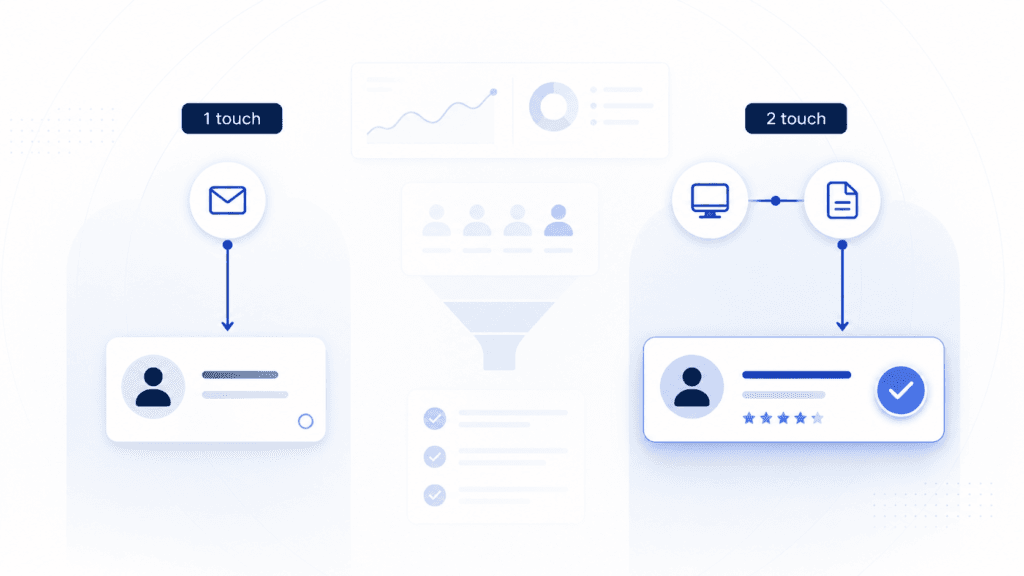
Single-touch leads usually come from one clear engagement or response, such as a content download, form fill, event action or campaign interaction. Double-touch leads usually involve a second qualifying action, confirmation step or engagement point before delivery.
Neither lead type is automatically good or bad.
Single-touch leads become risky when the client thinks they are buying sales-ready demand, but the campaign is only capturing one clear engagement signal. Double-touch leads become risky when the client assumes the second touch guarantees stronger intent, meetings or pipeline.
For agencies, the important job is to explain the delivery model before launch:
- what action creates the lead
- whether one touch or two touches are required
- what is checked before delivery
- what information the client will receive
- what the lead is suitable for
- what the lead is not proof of
- what counts as an accepted lead
- what rejection and replacement rules apply
MQL, HQL, single-touch and double-touch are useful labels only when they are tied to clear criteria. Without that, they create avoidable client disputes.
Why Lead-Type Language Creates Problems For Agencies
Clients often buy a lead programme with a mental picture already in place.
One client may think a lead means a person who downloaded content and matches the target profile. Another may think it means a named prospect who has been contacted, qualified and is ready for a sales conversation. A third may expect buying intent, budget, timescale and authority because the word “qualified” appeared in the proposal.
If the agency does not pin this down early, the first delivery file becomes the moment expectations collide.
That is a poor time to discover that:
- the client expected direct sales intent, not content engagement
- the client thought double-touch meant phone qualification
- the agency thought MQL meant profile fit plus engagement
- the fulfilment partner used HQL to mean a higher-friction form or extra question
- sales expected meetings, not leads for nurture or follow-up
- no one agreed what a valid rejection looked like
This is not just a terminology problem. It becomes a client-service problem.
The agency has to defend the campaign, explain the supplier, interpret the lead file, manage rejection comments and protect margin. The client may still be asking a simpler question: “Why did you call this a lead?”
What Is A Single-Touch Lead?
A single-touch lead is usually created from one qualifying interaction.
That interaction might be:
- a content download
- a form submission
- a webinar registration
- a campaign response
- a publisher or syndication engagement
- a target-account contact matching the agreed criteria
The important word is “usually”. Single-touch definitions vary by campaign and supplier. That is why agencies need the definition in writing before delivery starts.
A single-touch lead can be appropriate when the client wants reach, early engagement, content-led demand generation, nurture inputs, target-account coverage or sales follow-up into a defined audience.
Single-touch does not automatically mean low quality. A single-touch lead earns its place when the account, role, geography, source and required fields match the brief.
The risk comes when the client expects more than the touch model can prove.
A single-touch lead does not prove that the contact is in market. It does not prove budget. It does not prove authority. It does not prove that sales will accept the lead. It records one agreed engagement or qualification event, checked against the agreed rules.
That can still be valuable. It just needs to be sold and followed up honestly.
What Is A Double-Touch Lead?
A double-touch lead usually involves two qualifying interactions, confirmations or validation points before delivery.
Depending on the campaign, the second touch might be:
- a second content engagement
- a confirmation email
- a follow-up question
- an additional form field
- a phone or human validation step
- a second campaign interaction
- a check against a deeper qualification rule
Double-touch is not a magic quality label. It is only valuable if the second touch answers a question the client actually cares about.
For example, a second touch may help confirm that the contact is real, interested enough to engage again, or willing to answer a qualifying question. That can support a clearer handoff.
But it still does not guarantee pipeline. It does not guarantee meetings. It does not guarantee sales acceptance. It does not make the lead automatically better than a well-defined single-touch lead.
The agency needs to explain what the second touch is, why it matters and what it does not prove.
If the second touch is only a light confirmation, the client should not treat it as deep qualification. If the second touch is a human call, the agency needs to explain what was asked, what was recorded and what remains unknown.
Where MQLs And HQLs Fit
MQL, HQL, single-touch and double-touch are often treated as if they sit in one neat ladder of quality; they do not.
Single-touch and double-touch usually describe the engagement or validation model: what happened before the lead was delivered.
MQL and HQL usually describe qualification depth: how much evidence supports the handoff.
That distinction matters because a client may hear “HQL” and assume sales-readiness. A supplier may use “double-touch” to describe a second engagement. Sales may hear both and expect a lead that is ready for immediate outreach.
Those assumptions need to be cleared up before launch.
A lead label is only useful when the agency can explain:
- what the contact did
- what was checked
- what the label proves
- what the label does not prove
- what sales should do next
- what counts as accepted or rejected
For the core definitions, ABM Logic explains the difference between MQL, HQL and SQL lead definitions in a separate guide. In this article, the agency-side point is simpler: do not let the label carry more meaning than the process can support.
The label is not the handoff. The expectation is.
The Real Question Is Qualification Depth
The real question is not whether single-touch or double-touch is better.
The real question is: how much qualification does the client need before sales or marketing can use the lead properly?
Qualification depth can include:
- account fit
- role fit
- seniority
- geography
- company size
- sector
- content or campaign engagement
- business email validity
- exclusion-list checks
- declared interest
- qualifying questions
- phone validation
- acceptance criteria
- reporting evidence
Not every campaign needs every layer. Adding more friction can reduce volume, increase cost or slow delivery. Removing too much qualification can create rejection risk, wasted follow-up and awkward client conversations.
The agency’s job is to help the client choose the level of qualification that fits the campaign purpose.
If the goal is early-stage audience engagement, a well-defined single-touch lead may be enough. If the client expects closer sales follow-up, a deeper qualification model may be needed. If sales expects immediate meetings, the brief should treat this as a different delivery requirement rather than an assumed outcome from a lead programme. The qualification, follow-up and meeting expectations must be agreed before campaign launch.
What Agencies Need To Agree Before Launch
Before a fulfilment partner starts delivery, the agency and client need a clear launch agreement. It does not need to be complicated. It needs to remove the obvious ambiguity. See our guide to white-label fulfilment responsibilities.
Lead Type
Agree the label and the plain-English meaning.
For example:
- single-touch content engagement lead
- double-touch content syndication lead
- MQL based on profile fit and content engagement
- HQL based on agreed extra qualification fields
- validation-led lead checked against specified criteria
Do not rely on the label alone. Write down what the label means in the campaign.
Engagement Source
Agree what action creates the lead.
The source might be a content download, form fill, webinar registration, publisher engagement, campaign response or follow-up confirmation. If the client later challenges the lead, this source evidence becomes important.
The agency should be able to answer: what did this person actually do?
Required Fields
Agree which fields must be present before a lead is delivered.
That may include:
- first name
- last name
- business email
- company
- company domain
- job title
- country or region
- phone number, if part of the brief
- content or campaign source
- engagement date
- lead type
- QA or validation status
If a field is optional, say so. If a field is mandatory, do not let it become negotiable after delivery.
Acceptance Criteria
Acceptance criteria define what counts as a valid lead.
They may include account fit, role fit, geography, seniority, company size, sector, exclusion rules, source evidence, duplicate rules and required fields.
These criteria do not guarantee that sales will like every lead. They give the agency, client and fulfilment partner a fair basis for review and a more practical conversation about lead quality and pipeline.
Without criteria, every rejected lead becomes a subjective argument.
Rejection And Replacement Rules
Agree what qualifies as a valid rejection.
Useful rejection rules include:
- company outside agreed criteria
- contact outside agreed role or seniority
- geography mismatch
- duplicate under agreed duplicate rules
- missing mandatory field
- invalid business email
- excluded account
- source or engagement evidence missing
Also agree what does not automatically qualify as a rejection. A client preference change, a sales opinion or a new exclusion rule introduced after delivery may require a campaign adjustment, not an automatic replacement.
Replacement rules need boundaries. Unlimited replacement promises create margin pressure and supplier disputes.
Reporting Evidence
Agree what the report needs to show.
The report should help the agency explain:
- what lead type was delivered
- what engagement happened
- which criteria were checked
- which fields are complete
- which leads were borderline
- which leads were rejected
- what changed between batches
Reporting is part of the product. It is what lets the agency defend the campaign without relying on vague supplier reassurance.
When Single-Touch Leads Make Sense
Single-touch leads make sense when the client understands they are buying one clear engagement signal against agreed criteria.
They can work well for:
- content-led demand generation
- early-stage nurture
- target-account coverage
- webinar or event follow-up
- publisher or media-led campaigns
- campaigns where sales has a clear follow-up motion
- clients that need relevant contacts and account engagement, not immediate meetings
Single-touch becomes risky when the client expects the lead to behave like a sales-qualified opportunity.
The agency needs to say this clearly: a single-touch lead can show profile fit and engagement, but it does not prove buying intent, budget, authority or pipeline.
That does not make it weak. It makes it specific.
When Double-Touch Leads Make Sense
Double-touch leads make sense when the client needs more evidence before handoff.
They can work well when:
- sales needs a warmer follow-up reason
- the client wants extra confirmation before delivery
- the campaign needs additional qualifying fields
- the agency wants to reduce avoidable rejection risk
- the fulfilment partner can define and report the second touch clearly
The second touch needs a purpose. If it only adds friction without improving the handoff, it may make the campaign slower without making it meaningfully better.
Double-touch is strongest when the agency can explain:
- what the first touch was
- what the second touch was
- what the second touch confirmed
- what remains unproven
- how sales should follow up
That clarity matters more than the label.
Where Agencies Get Into Trouble
Most lead-type disputes start before delivery, not after.
The common problems are familiar:
- the proposal uses “qualified lead” without defining qualification
- the client assumes double-touch means sales-ready
- the agency assumes the client understands MQL and HQL language
- the fulfilment partner uses different lead definitions from the agency
- sales expects meetings from a content-led lead programme
- acceptance criteria are agreed verbally but not operationalised
- reporting shows lead count but not qualification evidence
- replacement rules are unclear until the first rejection batch
By the time the client is questioning the first file, the agency is already defending the work.
This is avoidable. The agency does not need to over-explain every detail, but it does need to explain the parts that affect trust: what happened, what was checked, what was not checked and what sales should do next.
How To Explain Lead Types Without Overpromising
Agencies need language that is clear enough for clients and careful enough for fulfilment reality.
Instead of saying:
- “These are high-quality leads.”
- “These are sales-ready leads.”
- “Double-touch leads are better.”
- “HQLs are ready for sales.”
Use language like:
- “This is a single-touch content engagement lead checked against the agreed account, role and field criteria.”
- “This double-touch lead includes a second agreed engagement or validation step, but it does not guarantee a sales conversation.”
- “This HQL label means deeper qualification than the MQL route we discussed, not a guaranteed meeting.”
- “The lead is accepted if it matches the criteria we agreed before launch.”
- “Sales follow-up should treat this as campaign engagement with defined context, not as a confirmed opportunity.”
Plain language protects the agency. It also helps the client use the leads properly.
Red Flags Before Campaign Launch
Pause before launch if:
- the client cannot define what a lead means
- sales expects meetings from a lead programme
- the client wants double-touch but cannot explain what the second touch should prove
- MQL, HQL and SQL are being used interchangeably
- acceptance criteria are still vague
- required fields are not agreed
- rejection rules are missing
- replacement rules are open-ended
- reporting fields are unclear
- the fulfilment partner cannot explain its lead definitions
- the client is buying volume while expecting deep qualification
These are not small details. They are the parts of the campaign most likely to create client escalation later.
What did the second touch actually add?
Before paying for double-touch delivery, ask the partner to describe both interactions separately. A verification call can confirm someone’s role without establishing that they are considering a purchase. A second content interaction can add context without becoming a meeting request. The label alone does not settle the question.
In our qualification process, verification and needs profiling serve different jobs. Buy the extra step when its answer changes how your team will follow up. If the receiving team would do exactly the same thing either way, revisit the brief before adding cost.
How ABM Logic Fits
ABM Logic works with agencies that need agency lead generation fulfilment to be clearer before delivery starts.
The useful conversation is not only “how many leads can we deliver?” It is:
- what type of lead is the client buying?
- what does the touch model prove?
- what does it not prove?
- what criteria will be checked?
- what will the client see in the report?
- what counts as accepted or rejected?
- how should sales follow up?
That is where agency fulfilment becomes safer. The campaign has a better chance of being judged against the right expectation, rather than against a vague idea of what a lead “should” have meant.
We help agencies agree the checks, the handover and how questions about lead quality will be resolved. If your client needs meetings or a confirmed project, bring that into the brief so we can assess the work required.
FAQs
What is the difference between single-touch and double-touch leads?
A single-touch lead usually comes from one agreed engagement or qualifying action. A double-touch lead usually involves a second engagement, confirmation or validation step before delivery. The exact meaning depends on the campaign and must be defined before launch.
Is a double-touch lead always better than a single-touch lead?
No. Double-touch is only better if the second touch adds useful evidence for the client. A well-defined single-touch lead can be more useful than a poorly defined double-touch lead.
Does a double-touch lead guarantee sales-readiness?
No. A second touch does not guarantee sales-readiness, meetings, pipeline or acceptance. It adds a defined extra layer of engagement or validation, depending on the campaign rules.
How do MQLs and HQLs relate to single-touch and double-touch leads?
MQL and HQL usually describe qualification depth. Single-touch and double-touch usually describe the engagement or validation model. They can overlap, but they are not the same thing.
What should agencies explain to clients before buying leads?
Agencies should explain the lead type, engagement source, qualification depth, required fields, acceptance criteria, rejection rules, replacement rules, reporting evidence and follow-up expectations before campaign launch.
What makes a lead acceptable?
A lead is acceptable when it matches the criteria agreed before launch. Those criteria may include account fit, role fit, geography, required fields, source evidence, duplicate rules and validation checks.
When should an agency ask for more qualification?
Ask for more qualification when the client needs a stronger handoff, sales has limited follow-up capacity, rejection risk is high, or the client expects more than one engagement signal can prove. More qualification should answer a real client question, not just make the label sound stronger.
If your agency is planning a lead programme, define the lead type before the client sees the first delivery file.
ABM Logic can help agencies clarify single-touch, double-touch, MQL, HQL, acceptance criteria and reporting expectations before campaign launch.
discuss lead type and acceptance criteria before campaign launch.