

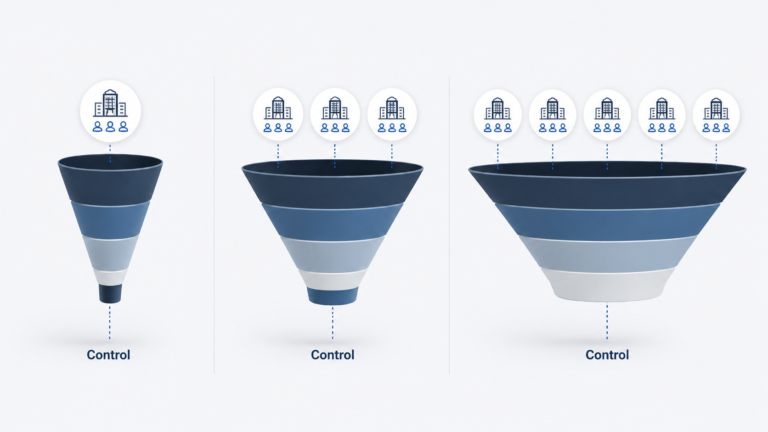

A priority account can justify a dedicated campaign, but its size alone isn’t a business case. Assess the opportunity with your sales team before approving the work.
At a glance
Consider one-to-one ABM when a valuable account has a specific barrier that individual research, tailored evidence and coordinated sales activity could help resolve. As the budget owner, compare that work with a smaller or shared programme. Approve a defined first phase, a next milestone and conditions for continuing.
Your sales colleague wants a dedicated campaign for an important account. The ideas are appealing: stakeholder research, a tailored proposition, perhaps an event built around that company’s priorities. Before approving the work, ask which obstacle those activities will help your team overcome.
One-to-one ABM makes sense when the account needs an argument, evidence or a route to the buying group that a shared campaign can’t provide. A prestigious logo doesn’t establish that need. Nor does a large potential contract tell you whether the account is accessible or your proposed activity will help it progress.
Our account-based work at ABM Logic starts with the target accounts, their business context and the people involved. The useful question is what your team needs to learn or change before committing to activation. Review that with the account owner, then fund a defined first phase rather than every possible deliverable at once.
Explain why this account needs individual attention
Write what you believe the account could buy, why it might matter and what needs to change before a buying process can advance. Distinguish a realistic use case from a theoretical total addressable opportunity.
An enterprise’s annual revenue isn’t a marketing business case. It doesn’t establish available budget, your ability to win, the contribution margin of a contract or the cost of delivery. Build the case around the specific opportunity and the evidence you have.
For an existing customer, the hypothesis may involve a new use case or division. For a new account, it may involve gaining credibility in a defined problem area. In either case, identify the milestone the programme should help achieve: a validated need, a new stakeholder relationship, an evaluation or a procurement invitation.
Four questions before you commit the budget
| Test | Evidence that supports investment | Warning sign |
|---|---|---|
| Commercial relevance | A plausible use case and meaningful contribution potential | Only a prestigious logo or large revenue figure |
| Account-specific barrier | A problem requiring tailored research, proof or relationships | A generic awareness task that many accounts share |
| Route to progress | An accountable sales owner and a credible contact or introduction route | No owner, no access plan and no next milestone |
| Delivery capacity | Time, expertise and assets available to act on the research | Bespoke work that can’t be maintained or followed up |
Use these four questions to structure the investment discussion. They won’t calculate a win probability for you, but they will expose assumptions you need to investigate before spending the budget.
A weak test need not mean rejection. It can mean a smaller research phase. For example, an account may look commercially attractive but have uncertain stakeholder access. Fund the work needed to resolve that uncertainty before approving an expensive activation programme.
Why perception can justify deeper work
In an ABM Logic account example, an established supplier needed credibility with a different buying group. Research into that group’s perception changed the proposition and the experience used to introduce the supplier’s wider capabilities. The documented milestone was an invitation into formal procurement, not a completed expansion sale.
The useful lesson is that an existing relationship can give you access without giving you credibility for a different problem. Your account team may be well regarded for one service while a new buying group has no reason to consider your wider capabilities. A dedicated programme needs to address that specific gap.
Edelman and LinkedIn’s 2025 thought-leadership research includes visible and less-visible decision-makers and examines content’s role in shaping consideration. It provides context for investing in useful thinking, but doesn’t prove that any particular bespoke asset will produce a deal.
The practical question is whether your proposed work changes the account’s understanding of a relevant capability. An expensive gift or event without that link may create activity without addressing the barrier.
Test the business case with explicit assumptions
Consider a fictional £30,000 programme aimed at a potential contract with £150,000 contribution before campaign cost. Suppose the team believes the win probability might be 10% without the programme and considers scenarios of 15%, 25% and 35% with it.
The expected incremental contribution in those scenarios is £7,500, £22,500 and £37,500 respectively, before deducting the £30,000 programme cost. The arithmetic is the change in assumed probability multiplied by contract contribution. It doesn’t validate the probabilities.
Under those assumptions, the campaign would need an improvement of twenty percentage points to cover its cost on that contract alone. That is a demanding assumption worth discussing. It may lead to a smaller first phase or a broader value case with separately evidenced benefits.
Include internal sales time, research, creative, media, event costs and follow-up. Avoid counting the same staff effort in two categories, but don’t call internal work free. Record which benefits are financial and which are strategic learning or relationship milestones.
Fund the next useful phase
The first commitment can be a foundations phase: account research, stakeholder mapping, internal alignment and a recommended play. Its output should be a decision, including the option not to proceed.
The second commitment can develop and test the proposition with a credible route into the account. The third can fund broader rollout once the team has evidence that the problem and approach are relevant.
Set review conditions at the start. If the account confirms the issue isn’t a priority, revise or stop. If a new sponsor emerges, adapt the plan. If the sales owner can’t support follow-up, resolve that constraint before adding activity.
This approach also makes a failed hypothesis useful. Learning that the proposed use case lacks internal ownership can prevent a much larger wasted commitment, provided the team records the finding rather than relabelling it as engagement.
Measure movement at the account level
Track changes in what the team knows, whom it can engage and which decision has advanced. Useful evidence can include a confirmed problem, an introduction to a missing function, an agreed evaluation criterion or a formal next step.
Keep those milestones distinct from opportunity value and won revenue. Our guide to ABM account progression explains why activity totals alone are inadequate.
Review both progress and cost. A programme may gain access while consuming more effort than expected. That can still be worthwhile, but the next investment decision should use the updated evidence.
Compare the bespoke programme with the best alternative
An investment case should include what the team would do if it didn’t approve one-to-one ABM. The alternative might be a shared account-cluster programme, normal sales coverage, a limited research assignment or a smaller customer workshop.
Estimate the additional work and the specific barrier the bespoke approach addresses. A £30,000 programme shouldn’t be justified against doing nothing if a £10,000 option could answer the same immediate question. Equally, a cheaper shared campaign may be inadequate when the account needs a genuinely different proposition and evidence base.
Consider concentration risk. If the entire quarter’s creative capacity is committed to one uncertain account, what happens to the rest of the pipeline? A commercially attractive account can still be the wrong sole priority for a small team.
6sense’s 2025 study found that respondents often had prior experience with shortlisted suppliers. This retrospective finding doesn’t establish your win probability. It makes existing familiarity and competitive position sensible research questions when assessing an individual account investment.
Write the stopping conditions before the first asset
Specify the evidence that would lead to a pause, a smaller scope or a different play. Examples include the relevant initiative being cancelled, the buying responsibility moving outside the target business or the account confirming that the proposed problem is already resolved.
Also distinguish a failed hypothesis from a delivery failure. If the team never reached the intended stakeholders, it hasn’t fully tested whether the proposition was relevant. If it reached them and they rejected the underlying problem, more creative may not help.
At each review, record actual cost, completed work, account response and the next uncertainty worth resolving. Don’t continue solely because earlier money has been spent. The next phase should have its own justification based on the evidence now available.
Keep asking whether the next phase deserves the next pound of investment. That makes it easier to act on what you’ve learned, even when the right decision is to narrow the programme or stop.
Agree what you’re approving now
Approve a defined phase, budget, owner, milestone and review date. State the current hypothesis, the main uncertainties and what would cause the team to change course. That is more useful than declaring an account “strategic” indefinitely.
If several accounts share the same problem and proof needs, consider whether a cluster can do the job. If the barrier is unique and commercially meaningful, ABM Logic’s account-based marketing work can help turn that case into an individual account programme.